
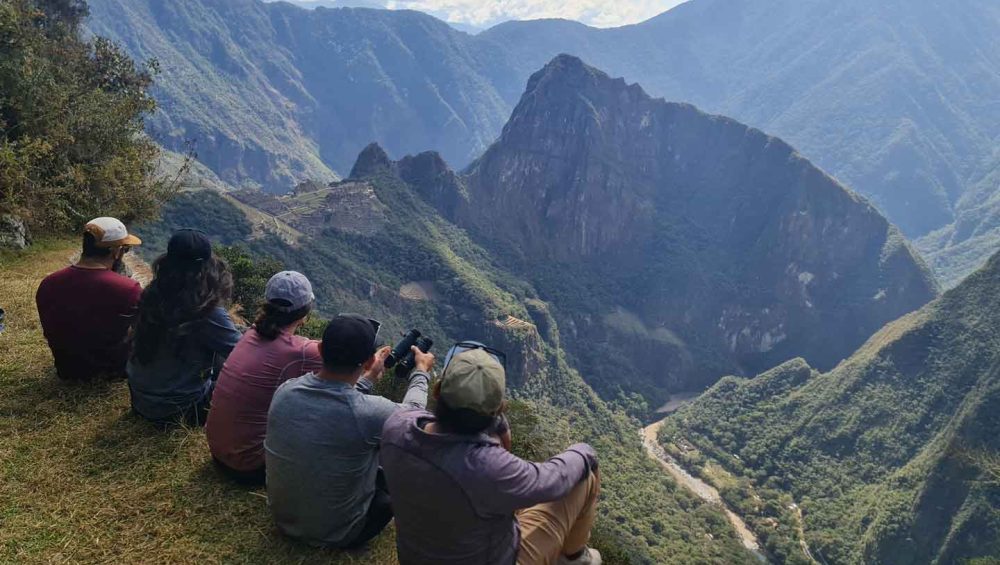
The citadel of Machu Picchu stands out not only for its remarkable state of architectural conservation but also for the complex urban planning adapted to its surroundings. Historically, access to this llaqta (Inca urban and religious center) was strictly regulated. Today, for travelers who start their vacation in Machu Picchu through the Classic Inca Trail trek, the first visual contact with the sanctuary happens exactly from the same approach point used by the ancient Incas: the Inti Punku (Sun Gate).
Furthermore, the Quechua term Inti Punku translates as “Sun Gate”. On an archaeological and structural level, this sector is made up of a system of terraces, steep stairs carved into bedrock, and stone enclosures. The layout of these walls shows that the place worked as a control and security post, designed to register and authorize the movement of people entering or leaving the sacred perimeter.
This control point is located at an approximate distance of 2 kilometers southeast of the main urban core. Its topographic location at the top of the mountain ridge is no accident; it was carefully calculated by the Incas to have visual control of the surroundings. From its terraces, the visitor gets the classic panoramic view that frames the agricultural and urban sectors of the stone city, topped in the background by the imposing peak of the Huayna Picchu mountain.
History and function of the Inti Punku
During the peak period of the Tahuantinsuyo (Inca Empire), the Sun Gate operated as the main control post for foot traffic to Machu Picchu. Being directly connected to the road network of the Qhapaq Ñan, it was the mandatory arrival and registration point for traveling groups.
Because of its topography and location, researchers and archaeologists suggest that access to the citadel was strictly restricted. Machu Picchu worked as a religious sanctuary and administrative center for the elite, so the Inti Punku served as a security filter where the imperial guard authorized entry. Consequently, this restriction meant that pilgrims who managed to enter the site and later returned along this same route were treated with deep respect by the people of the nearby valleys.
Astronomical engineering and architecture
The name “Sun Gate” is not just a figurative title, but it answers to a precise calculation of astronomical observation. The complex, made up of terraces, walls with niches (windows), and stone portals, was designed in alignment with the solar path. During the dawn of the summer solstice in the southern hemisphere (December 21), the sun rises exactly behind the portal of the Inti Punku, projecting its rays directly toward specific sacred sectors of the urban core, like the Temple of the Sun.
On an architectural level, the site is a large structure supported by retaining walls adapted to the mountain ridge. Its high position gives it a visual and tactical command of the environment, allowing you to observe the entire llaqta (city) of Machu Picchu, the bottom of the canyon where the Vilcanota (Urubamba) river flows, and the chain of guardian mountains that surround it, highlighting the peak of Huayna Picchu.
The Inca Trail and access through the Inti Punku
Topographically and logistically, the Inti Punku site forms the official ending point of the four-day Classic Inca Trail expedition. For hikers who travel this part of the road network (Qhapaq Ñan), crossing through the walls of the Sun Gate represents the first direct visual contact with the Historic Sanctuary of Machu Picchu, keeping exactly the same approach perspective used by groups in pre-Columbian times.
From this ancient checkpoint, the final stretch to the main urban core consists of a continuous descent through a stepped stone path. On a physical demand level, this final descent is much less tough than the climbs to the mountain passes of previous days. This topographical advantage, added to the visual command of the landscape, allows expedition members to move more smoothly toward the agricultural zone while observing the panoramic progression of the citadel and its integration with the Vilcanota river canyon.
How to get to the Sun Gate from the citadel?
For regular visitors entering Machu Picchu (without having done the Classic Inca Trail), the climb to the Inti Punku is done in reverse. The route starts in the upper agricultural terraces sector of the citadel. The trail is properly marked with wooden panels and goes almost parallel to the route that leads to Machu Picchu Mountain, although it has a much lower slope and physical demand level. It should be noted that to enter this site it is necessary to buy Circuit 1 (Route 1-C: “Intipunku Portal Route”) which is only available in high season.
Note: It should be noted that, according to current regulations of the Ministry of Culture, to enter this site it is necessary to buy the ticket corresponding to Circuit 1 (Route 1-C: “Intipunku Portal Route”). On a logistical level, this circuit is open to the general public exclusively during the high tourism season.
It is important to point out that the Sun Gate works as a transit border for visitors. The paved stone path continues going down beyond the Inti Punku for about two hours until connecting with the Wiñay Wayna archaeological complex; however, access to this stretch is strictly forbidden for the general public and guarded by park rangers, since traveling it requires having the official Inca Trail permit.
Technical sheet of the hike to the Inti Punku
To properly plan this extension route within the sanctuary, consider the following technical and logistical data:
- Estimated time: Between 3 and 4 hours (round trip), depending on the walking pace and breaks for acclimatization.
- Maximum altitude: 2,720 meters above sea level (masl).
- Topographical elevation gain: An ascent of 290 meters in relation to the urban sector of Machu Picchu.
- Terrain type: Packed dirt roads and original Inca stone paths with irregular stairs.
- Recommended equipment: Light trekking boots or sneakers with non-slip soles. (Note: For foot health on long hikes, it is advised to use previously broken-in footwear, never new).
- Operating hours: Access is aligned with the general park schedule (from 06:00 to 16:00 hours, having to leave the site at 17:00 hours). For safety and visibility rules, it is not recommended to start the climb after 14:00 hours.
- Entry requirements: To do this hike, it is mandatory to buy the specific ticket that includes access to the Sun Gate (Inti Punku) circuit. Entry is subject to availability and the daily capacity regulated by the Ministry of Culture.
When to visit this site?
The Historic Sanctuary of Machu Picchu is located in a jungle brow area, which gives it a subtropical climate throughout the year, with an average temperature around 18 °C.
To plan the climb to the Inti Punku, it is important to consider the environmental factors:
- Dry season (May to October): It matches the high tourist season (when route 1-C is open). It has mostly clear skies and an environmental humidity level between 40% and 45%.
- Rainy season (November to April): Humidity increases to reach between 60% and 65%, with a high chance of heavy rain that can make the stone path slippery.
On a logistical level, it is suggested to start the hike during the early hours of the morning to take advantage of the shade cast by the mountain and avoid the physical exhaustion caused by the direct midday sun.
Update on the entry ticket (2026)
It is essential to clarify that the old general access ticket is no longer valid for this hike. As mentioned in the technical sheet, the visitor does need a specific ticket: the ticket for Circuit 1 (Route 1-C: Intipunku Portal Route).
Operationally, if the traveler has a tight schedule and has their return train from Aguas Calientes scheduled around 14:00 hours, it is strictly necessary to start the climb to the Sun Gate before 10:00 a.m. This will guarantee having enough time (3 to 4 hours) to complete the route and go down to the town without the risk of missing the train transport.
Level of physical demand
Technical classification: Moderate difficulty.
Unlike the expeditions to the peaks of Huayna Picchu or Machu Picchu Mountain, which have extreme slopes and cliffs, the route to the Sun Gate demands a medium level of physical condition. The trail is characterized by being topographically wider and having less uneven stone stairs. However, since it is a continuous climb in altitude, it requires a steady walking pace and strategic breaks for hydration.