
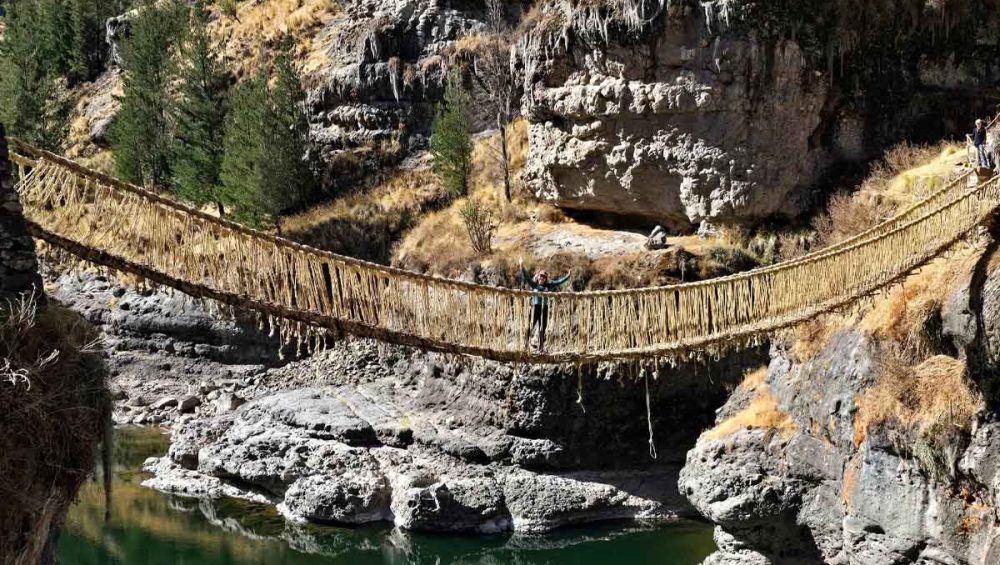
Deep in the southern Peruvian Andes, over the freezing waters of the Apurimac River, lies the last Inca bridge: the Qeswachaka. It is not made of steel or concrete, but of hand-woven plant fiber, following techniques that the Incas perfected over five centuries ago.
What makes this bridge unique is not only its age, but the fact that it still survives, thanks to the fact that every year, four Quechua communities gather to take it down and weave it again completely; all this in a ritual that combines ancient engineering, community organization, and a deep spiritual connection with nature. This work is, without exaggerating, the last Inca hanging bridge that still fulfills its original purpose.
In this guide we tell you what exactly the Qeswachaka is and why UNESCO recognized it as Intangible Cultural Heritage of Humanity, what the fascinating annual renewal ritual is like, what the best way to get there from Cusco is, what other landscapes you can see on the way, and everything you need to know before planning your visit.
What is the Qeswachaka bridge?
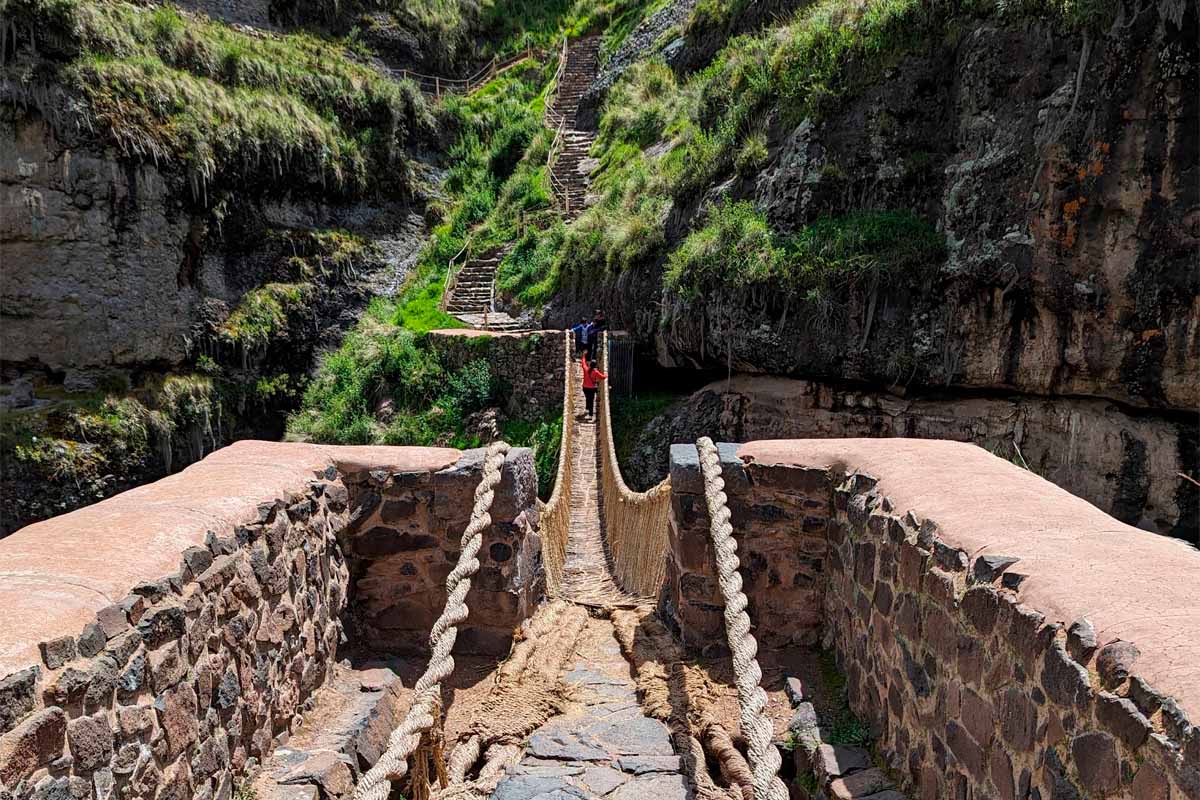
The Qeswachaka is a hanging bridge built entirely with plant fiber, without a single nail, screw, or metal support. Its name comes from Quechua and means “rope bridge”, an exact description of its structure: six thick hand-woven ropes, four that form the base and two that work as handrails, held by stone bases at each end of the gorge.
It is the last Inca bridge that continues to work just as the inhabitants of the Tahuantinsuyo used it, and that is why it has earned a place among the most unique sites in southern Cusco.
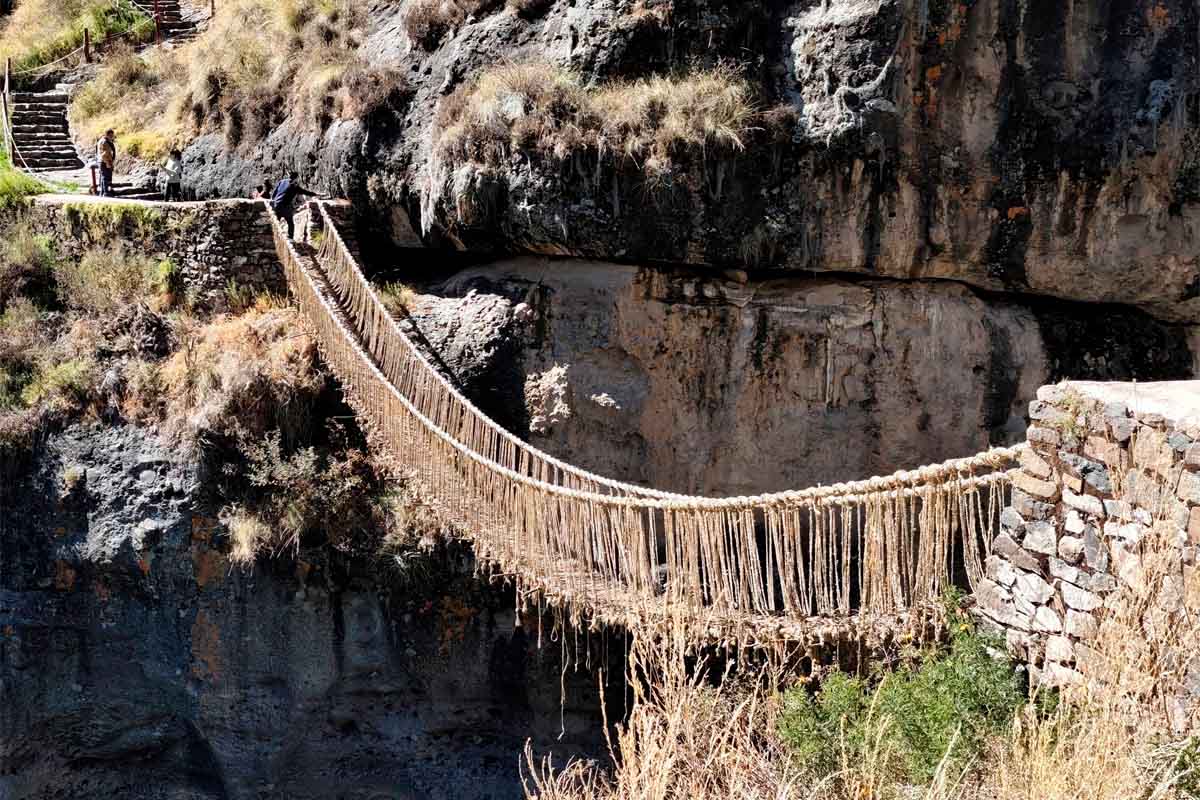
Location over the Apurimac River, in the Canas province
The bridge crosses the Apurimac River canyon, in the Quehue district, Canas province, at an altitude close to 3,700 meters above sea level. It is about 28 meters long and 1.20 meters wide, and connects both sides of the canyon, allowing passage between communities that for centuries depended on it to connect.
Recognition as Intangible Cultural Heritage of Humanity
In 2013, UNESCO included the knowledge, techniques, and rituals linked to the annual renewal of the Qeswachaka on the Representative List of the Intangible Cultural Heritage of Humanity. The recognition does not only fall on the physical structure, but on the whole process that keeps it standing: the community organization, the passing of techniques between generations, and the relationship with the natural environment that its reconstruction every year involves.
History and meaning of the bridge
During the peak of the Inca empire, the hanging bridges made of plant fiber were a key piece to maintain the territorial control of the Tahuantinsuyo. Without them, crossing the deep Andean canyons would have been almost impossible, and communication between regions as far away as Cusco and the southern territories could not have been kept with the speed the empire required.
-
Origin in the Tahuantinsuyo road network (Qhapaq Ñan)
The Qeswachaka was part of the Qhapaq Ñan, the large road system that connected different regions of the Inca empire along the Andes. This bridge allowed crossing the Apurimac river canyon at a strategic point in the road network, connecting the chasquis (Inca messengers), traders, and armies that traveled between Cusco and the south of the territory. It is estimated that techniques similar to those used in the Qeswachaka held up dozens of bridges across the empire, in a time when Andean engineering solved with plant fiber what other cultures solved with stone or metal.
-
Why is it the only Inca hanging bridge still standing?
Out of all that bridge network that once crossed the Andes, the Qeswachaka is the only one that remains working with the original method. Its continuity is not because it has stood intact for centuries, but because of something different: every year, before the natural wear of the fibers makes it weak, the local communities take it down completely and weave a new one in its place. That constant renewal is what has allowed the Inca technique of building with plant fiber to reach today intact, while the rest of similar bridges disappeared over time when they stopped being maintained.
The annual renewal ritual
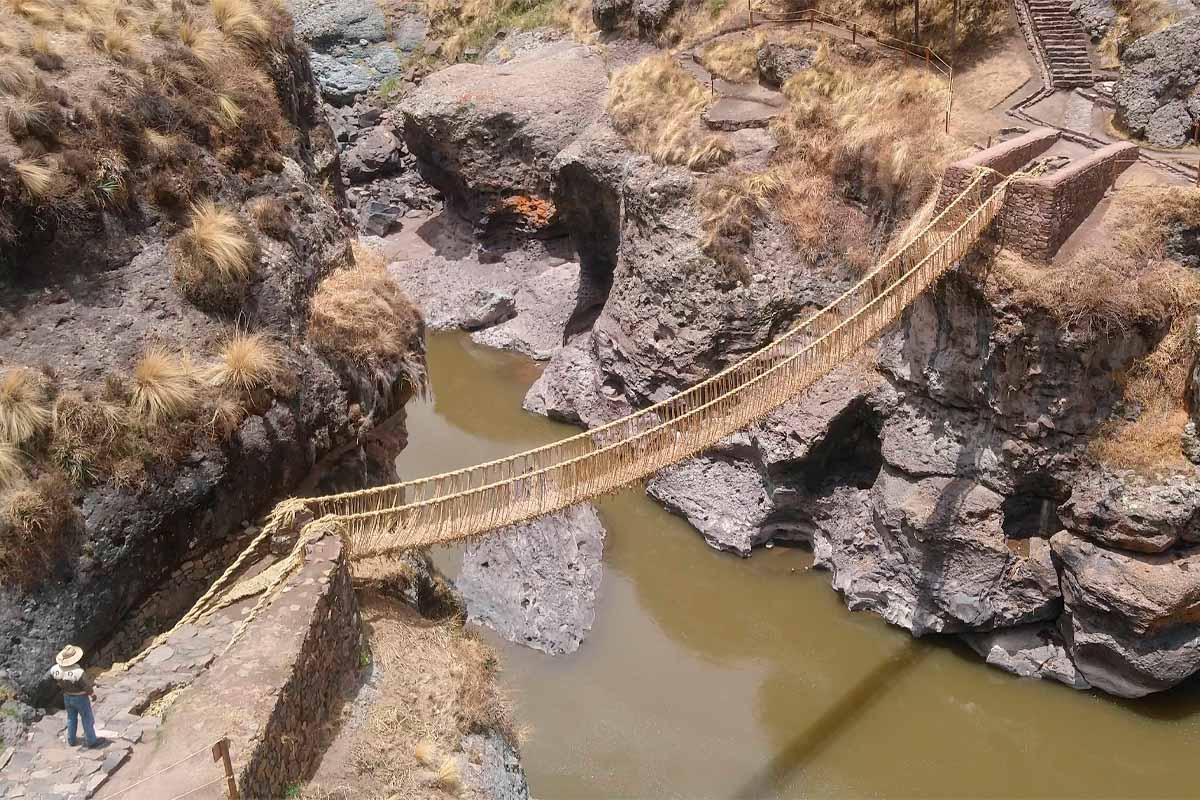
Every year, when the fibers of the bridge already show signs of wear, a group of Andean communities organizes to carry out one of the most unique traditions still practiced in the Andes: taking down the old bridge and weaving a completely new one in its place, using the same techniques passed down from generation to generation since the Inca times.
The renewal gathers the people of four farming communities of the Quehue district: Huinchiri, Chaupibanda, Ccollana Quehue and Choccayhua. Each one has a role in the process, and participation usually involves whole families, from those who prepare the plant fiber to the master weavers who direct the building of the main ropes. It is a community task, known in the Andean tradition as minka, in which work is organized by shifts and benefits everyone equally.
The main material to weave the new bridge is q’oya, a plant fiber from the same family as ichu, the typical grass of the Andean highlands. Weeks before the renewal, families cut and braid this fiber into thin ropes several meters long. With those ropes, under the guidance of master weavers, the six thick ropes that hold the bridge are formed: four that act as a base and two that serve as handrails. Finally, those ropes are tied to the stone bases located at each end of the canyon, just as it has been done for centuries.
How to get to Qeswachaka from Cusco
Getting to the Qeswachaka bridge requires some planning, as it is quite far from the city and there is no direct public transport to the place. However, the trip itself is part of the experience, as it goes through Andean landscapes that few tourists get to know.
Approximate distance and travel time
The bridge is located about 110-160 kilometers southeast of Cusco, in the Quehue district, Canas province. The road trip takes between 3 and 4 hours, depending on the chosen route, the type of transport, and the weather conditions, which can affect the dirt road sections in the last part of the trip.
Access routes (Cusipata, Combapata)
There are two main routes to get there from Cusco.
- The first one goes through Cusipata and Yanaoca, a road that many travel agencies use for their one-day tours.
- The second one goes towards Combapata and Sicuani, following part of the road to Puno, and then turns towards Quehue.
Both options meet at some point before reaching the bridge, and the choice usually depends on whether you also plan to visit the nearby lakes and towns on the way.
Tips for those traveling on their own
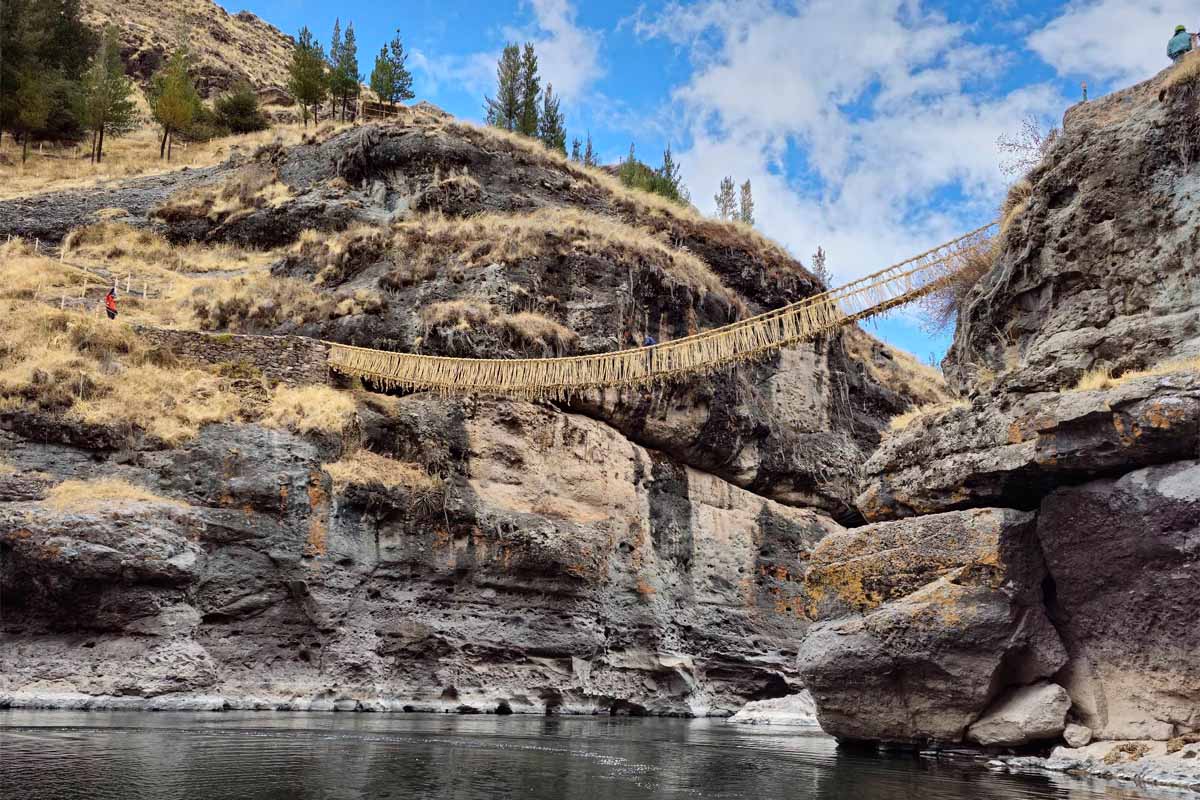
If you decide to go without an agency, keep in mind that there is no direct public transport to the bridge. One option is to take a bus or shared van from Cusco to Sicuani or Combapata, and from there take local transport to Quehue, the closest town to the bridge. It is also possible to hire a private taxi for the whole trip, although the cost will be much higher. Before leaving, it is a good idea to confirm the schedules of the shared vans, as they are usually limited outside the renewal ceremony season, and bring cash, because there are no ATMs in the area.
What to see on the way?
The trip to Qeswachaka goes through one of the least explored areas in the south of Cusco, with landscapes that are well worth the hours of travel, even before getting to the bridge.
- The nearby lakes: Pomacanchi, Acopia, Asnaqocha and Pampamarca
On the route there is a group of high Andean lakes known as the four lakes circuit: Pomacanchi, Acopia, Asnaqocha and Pampamarca. Each one has its own character: Pomacanchi is the largest and is usually a stop to watch birds; Acopia and Pampamarca stand out for their calm waters surrounded by reeds; and Asnaqocha, smaller, offers a quiet setting away from the usual route. Many one-day tours include short stops at one of them before continuing to the bridge. - Andean towns on the route
The road also passes through small towns like Cusipata, Yanaoca, Checca and Quehue itself, where customs and ways of life typical of the Andean rural world are still kept. In these places it is common to see the locals working in farming and raising camelids, as well as local markets where you can try typical food of the area. Stopping in any of these towns, even for a short time, allows you to get to know a side of Cusco very different from what is seen in the city.
Best time to visit Qeswachaka
The Qeswachaka bridge can be visited all year round, but the experience changes a lot depending on the chosen date. Visiting it during the renewal ceremony, in June, allows you to see the weaving process and the celebrations that go with it up close, although it also means more tourists and some access limits while the work is being done. Outside of those dates, the bridge can be explored calmly, without crowds, in a much quieter setting, ideal for those looking for a more thoughtful experience.
As for the weather, the dry season (from April to October) offers clear skies and less chance of rain, which makes road travel easier. During the rainy season (November to March) the road can get difficult in some sections.
Entry cost and if a guide is required
Entry to the bridge costs 20 soles per person (about 6 dollars), although in some seasons or depending on local plans the charge can vary to 10 soles.
The entry is managed by the local communities of Quehue, so the payment is only in cash and in Peruvian soles; preferably bring small bills or coins, since cards or digital payments are not accepted.
If you travel on a tour, most agencies in Cusco offer the “Qeswachaka and the 4 Lagoons Full Day Tour” for a price between 120 and 250 soles (about 35 to 40 dollars). It is a good idea to check the booking well, since some agencies include the entry in the total price and others charge for it separately when you arrive.
It is not required to hire a guide to visit the bridge, especially if you travel on your own, although having one helps to better understand the cultural meaning of the place and makes the trip logistics easier, in particular if stops at the lagoons and nearby towns are included.
Frequently asked questions
- Can you cross the bridge?
Yes, the bridge is open for visitors to cross all year round, except at specific times when the communities do maintenance work or the yearly renewal, when access can be temporarily restricted. - Is it safe to visit it on your own?
Yes, it is possible to visit it without an agency. The main challenge is not the safety of the bridge itself, but the trip logistics, since there is no direct public transport and the final sections can be a bit difficult without your own vehicle or prior knowledge of the route. - How long does the tour from Cusco take?
A full day tour usually takes between 8 and 10 hours in total, counting the round trip, the stops along the way and the time at the bridge. - Is it the same Inca bridge seen in Machu Picchu?
No. The Inca bridge in Machu Picchu is a different structure, made of stone and wood, that is part of the path that surrounds the citadel and is currently closed to the public for safety. The Qeswachaka, on the other hand, is an independent plant fiber hanging bridge, located in the Canas province, and it is the only one still in use. - Is there a risk of altitude sickness?
The bridge is located at almost 3,700 meters of altitude, a similar height to Cusco, so the risk is low if you arrived already acclimated to the city. Even so, it is recommended to take it easy, stay hydrated and avoid intense physical effort during the visit. - Can it be visited in a combined tour with other attractions?
Yes, several agencies offer tours that combine the visit to Qeswachaka with the four lagoons circuit or with stops at nearby Andean towns, taking advantage of them being on the same route. - When is the renewal of the bridge done?
The renewal is normally done during the second half of June, although the exact date can change from one year to another depending on the agreements between the participating communities and the Quehue district authorities. The whole process usually takes three days of work, followed by a fourth day of community celebration once the work is finished. - How is the bridge from the previous year taken down?
Before weaving the new bridge, it is necessary to remove the previous one. The communities cut the ropes that hold the structure from last year, which by that time has already lost a good part of its strength due to the natural wear of the plant fiber. In the Andean worldview, this moment has a special meaning: the bridge “dies” to make way for a new one that will be “born” again with the joint work of the community.