
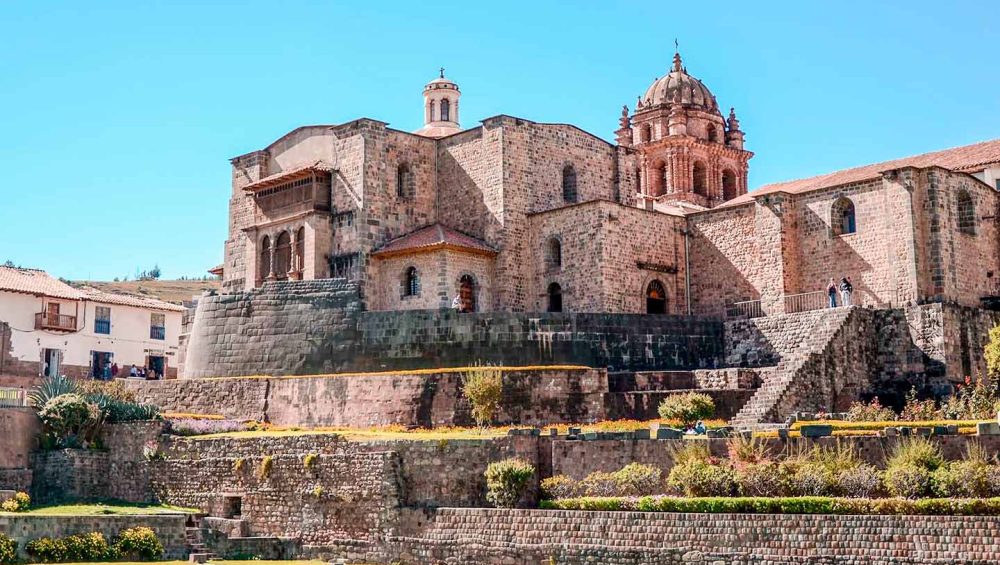
The Qoricancha was the most important religious building of the Inca Empire, and centuries after it was built, it is still one of the most impressive sites in Cusco.
To understand its historical weight, you have to understand how the Incas saw it: this temple was not just a place of worship. It was the center of the Tahuantinsuyo, the point from which both the city of Cusco and the Empire as a whole were organized, in religious, geographic, and political terms at the same time. All the towns that were part of the Empire came together here to pay tribute to the god Inti, the Sun, the supreme deity of the Andean culture.
The architecture shows this. Every detail of the Qoricancha was designed with a technical, symmetric, and astronomical precision that has no comparison in the region. It was not just a beautiful temple: it was a statement of power and knowledge built in stone. What was left after the Spanish conquest, when the colonizers built a Dominican convent on its walls, is still enough to understand why this place held the position it held in the Inca worldview.
History of the Qoricancha: the epicenter of the Empire
The temple we know today as Qoricancha did not always have that name. In its origins, around the year 1200 A.D., it was built under the rule of the Inca Wiracocha with the name of Inticancha or Intiwasi, which in Quechua simply means House of the Sun. It was already a religious site then, but what came next turned it into something completely different.
With the rise of Pachacutec, the Inca who redesigned Cusco and expanded the Empire to its largest size, the temple got its current name and its most monumental shape. Likewise, the walls were covered with sheets of gold, silver, and precious stones, and the complex became the most important ceremonial center of the Tahuantinsuyo. The chronicles of the time describe a shine that was visible from far away and that served as a constant reminder of the power of the Sun god and the Inca who represented him on earth.
However, the Spanish conquest changed all of that very suddenly. The treasure of the Qoricancha was looted and, according to several historians, a large part of it was moved to Cajamarca to pay the ransom of the Inca Atahualpa. The temple first passed to the hands of Francisco Pizarro and then to the Dominican order, who destroyed the upper structures of the sanctuary to build the convent and the Church of Santo Domingo on top. A decision that was as intentional as it was symbolic: to erase the past by building on its bases.
Throughout the centuries, the colonial building suffered three devastating earthquakes: in 1650, 1749, and 1950. In each of them, the Christian church collapsed and in each event, the Inca retaining walls remained intact. The stone that the builders of the Tahuantinsuyo put together without mortar resisted what the colonial architecture could not.
Since 1956, the restoration work on the complex has been freeing and showing those original walls, which today are the most visited and studied part of the site. A history that, told by the stones, does not need too many words.
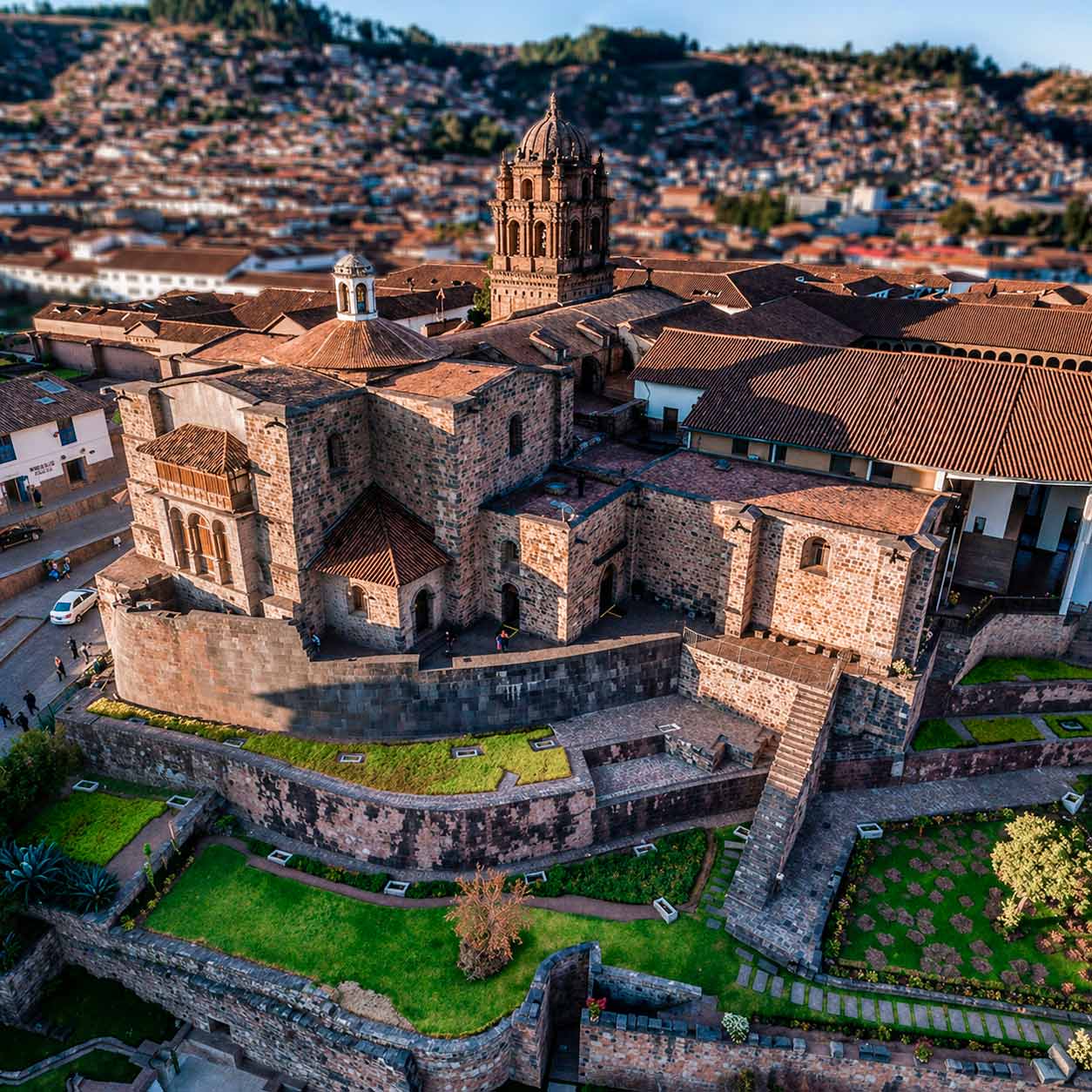
Who were the first architects of the Qoricancha?
The history of the Qoricancha begins before the Incas. Several chroniclers agree that the first to build a temple honoring the Sun in that place were the Ayamarcas, the native ethnic group that dominated the Cusco valley around the 13th century. They were the ones who built the initial site and gave it its first name: “Inticancha”.
The Ayamarcas were not a small people. They controlled the Andean region with enough strength to maintain a long and territorial rivalry with the Incas for the control of the valley, a dispute that lasted for years and was not easily solved. It was only during the rule of the Inca Wiracocha that the Ayamarcas were finally defeated and added to the Tahuantinsuyo.
With that addition, the temple they had built passed into Inca hands, and what came next (the transformation of the “Inticancha” into the Qoricancha we know) was possible exactly because there was something there before. A detail that is often lost in stories about the Inca Empire, but that says a lot about how the expansion of the Tahuantinsuyo worked: they did not always build from zero, but rather they recognized what they found and added it to their own logic.
What does Qoricancha really mean?
The name says almost everything, if you know how to read it. Qoricancha (also written Koricancha or Coricancha) is usually translated as “Temple of gold”, and comes from two Quechua words: “Quri”, which refers to finely worked gold, and “Kancha”, which means a fenced space or limited by walls. The most exact translation would be something like “fenced site that contains gold”, which turns out to be a fairly exact description of what this place was in its best moment.
Architecture of the Qoricancha: engineering and cosmic devotion
The Qoricancha was not a temple for a single god. It was a complex that gathered inside five sacred sites, each one dedicated to a different force of the Andean worldview: the Sun as the main deity, and next to it the Moon (“Killa”), the Lightning (“Illapa”), the Rainbow (“K’uychi”) and the stars (“Chack’a”). A complete universe represented in stone and gold within the same site.
And the gold was not just decorative. A continuous strip of pure gold ran along the entire edge of the complex at three meters from the ground, visually uniting all the sectors. The threads that held the straw roofs were also forged in gold, resting on stone walls assembled with that characteristic precision of Inca architecture: without mortar, without gaps, with blocks that fit together.
What is left today is a fraction of what it was. But even so, it is enough to understand why this place occupied the center of the Inca empire.
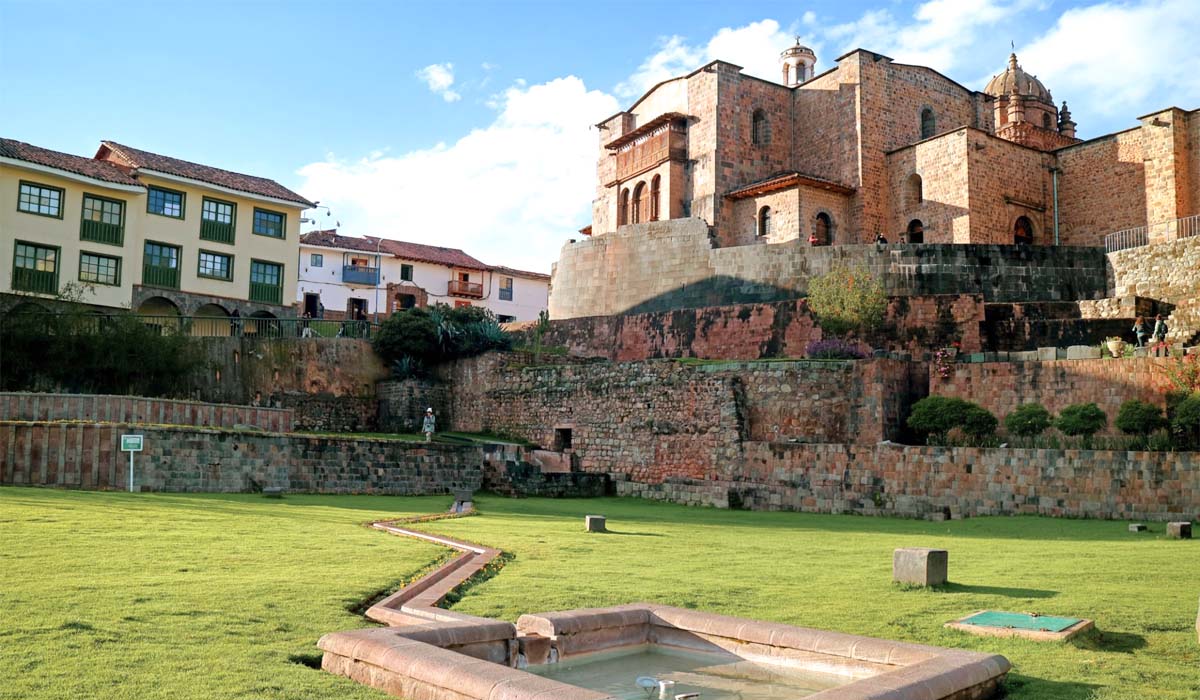
How to get to the Qoricancha?
The Qoricancha is right in the center of the city of Cusco, at the intersection of El Sol Avenue and Santo Domingo street, just two blocks from the Main Square. It is one of those places that can be found walking without major difficulty from any point in the historic center.
If you prefer to visit it with context and without worrying about logistics, the most complete option is to join a “City Tour Cusco“, which includes access to the Qoricancha along with transport and a professional guide throughout the tour. A good way to use your time and take each visit much further than what is achieved by exploring alone.
Schedules and entry costs
The Qoricancha opens from Monday to Saturday from 9:00 a.m. to 5:00 p.m. On Sundays the schedule is reduced: only in the afternoon, from 2:00 p.m. to 5:00 p.m., so it is good to keep this in mind when planning the visit.
The entry costs S/ 15.00 for national and foreign visitors equally. An important detail: access to the Qoricancha is not included in the Cusco Tourist Ticket, so it must be bought separately directly at the complex’s ticket offices.
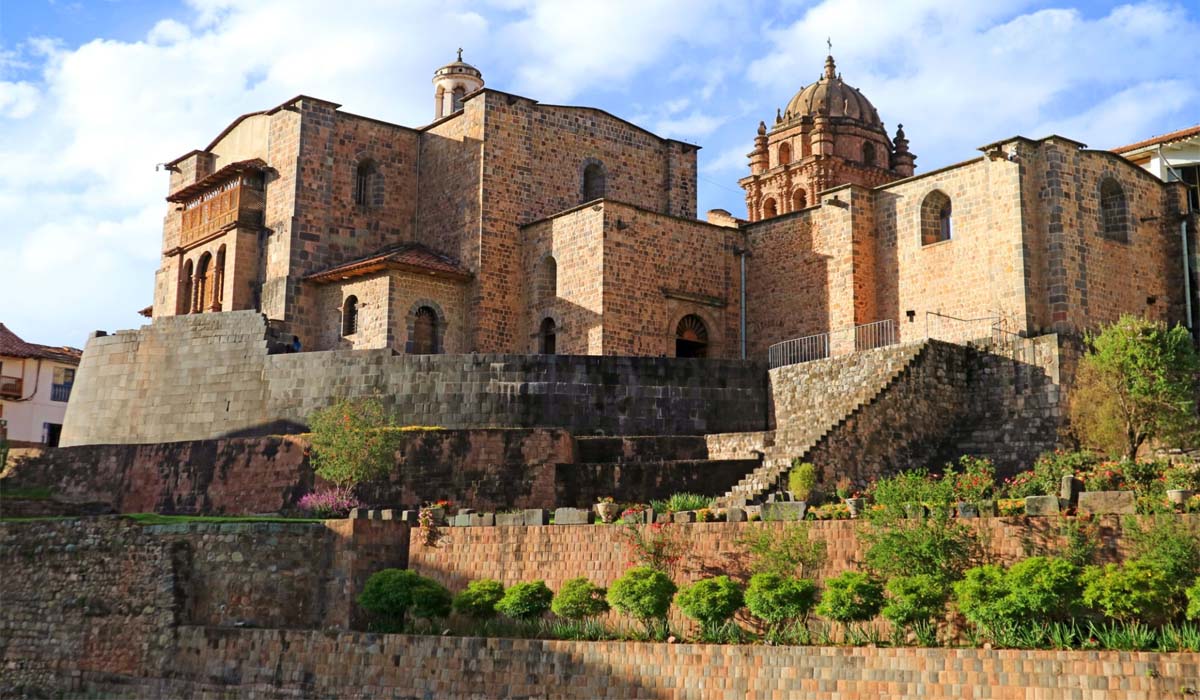
Attractions of the Qoricancha: a tour of the sanctuary
What Garcilaso de la Vega describes in his chronicles and what can still be seen today have a surprising consistency, considering everything the site has been through. Having said that, we must be honest: what is left is a fraction of what it was. Walking through the Qoricancha today is walking through the echo of something much bigger. Below, we present the attractions that you can see if you visit this temple:
-
The Temple of the Sun
The heart of the complex. This room originally took up more than half the width of the current Santo Domingo Church, and what it held inside was hard to imagine even for those who described it at the time. According to Garcilaso, the walls were covered with gold plates, and on the altar rested a solid gold disk that represented the Sun god. The embalmed bodies of the “children of the Sun” were ordered by age on chairs and tables of the same metal. The western end corresponds today to the architectural drum that faces El Sol Avenue, and the eastern end reached the atrium of the current church.
-
The Temple of the Moon
Next to the main temple, the Moon room held a position of honor: the lunar deity was considered the partner of the Sun, and her temple reflected that. The walls were covered with silver boards, and inside there was a representation of the Moon in the same metal. The mummies of the Coyas (the Inca queens) rested here in order of age. About half of this temple was destroyed to build the central nave of the Dominican church; its remains can be seen today on the western side of the inner courtyard.
-
The Temple of Venus and the Stars
Very close to the lunar room, separated by an alley, is the sector dedicated to Venus (known in the Andean worldview as Chasca, the star) and the starry sky. It was the space from where the Inca led parties and ceremonies in the rectangular courtyard next to it, completing the western block of the inner courtyard.
-
The Temple of Illapa
In front of the temple of Venus is the room dedicated to Illapa or Chuki Illapa, which in Quechua represents the power of the lightning bolt, the lightning and the thunder. Architecturally, it stands out for its three simple jamb doors, equally spaced and slightly trapezoidal, with a window on each side wall. A precise design that leaves nothing to chance.
-
The Temple of K’uychi
Next to the Illapa temple, this temple was dedicated to the Rainbow, a phenomenon that according to Andean beliefs came directly from solar energy. It shares the same architectural features as the Illapa room, although a part was destroyed during colonial times to build the foundations of the Dominican convent. Its remaining walls are found to the north of Illapa, in front of the Temple of the Moon.
-
Intipampa: the Plain of the Sun
In front of the main temples, like in almost all great civilizations, the Incas built a wide open space where nobles, courts, servants, and dancers gathered while the elite entered the Qoricancha for the ceremonies. That open space (the Intipampa) is today the Santo Domingo Square, and it keeps its original limits and sizes almost intact.
-
The Solar Garden
In the western part of the complex was the Solar Garden, which worked as the great exhibition space for offerings brought by all the nations of the Tahuantinsuyo. The chroniclers describe representations of the Empire’s plants and animals made of gold and silver at life size, filling the terraces. It was the Spanish who gave it that name, impressed by the number of farming terraces, before turning it into the friars’ orchard. Today it can be seen from El Sol Avenue.
-
The Sacred Fountains
The Qoricancha also had a water system of five water fountains, whose underground origins were a state secret. They had a purifying religious meaning and were decorated with precious metals. In the central courtyard of the complex, you can still see one of them, carved with perfect octagonal corners. A small detail that says a lot about the level of attention that was put into every element of this place.
About the Qoricancha Site Museum
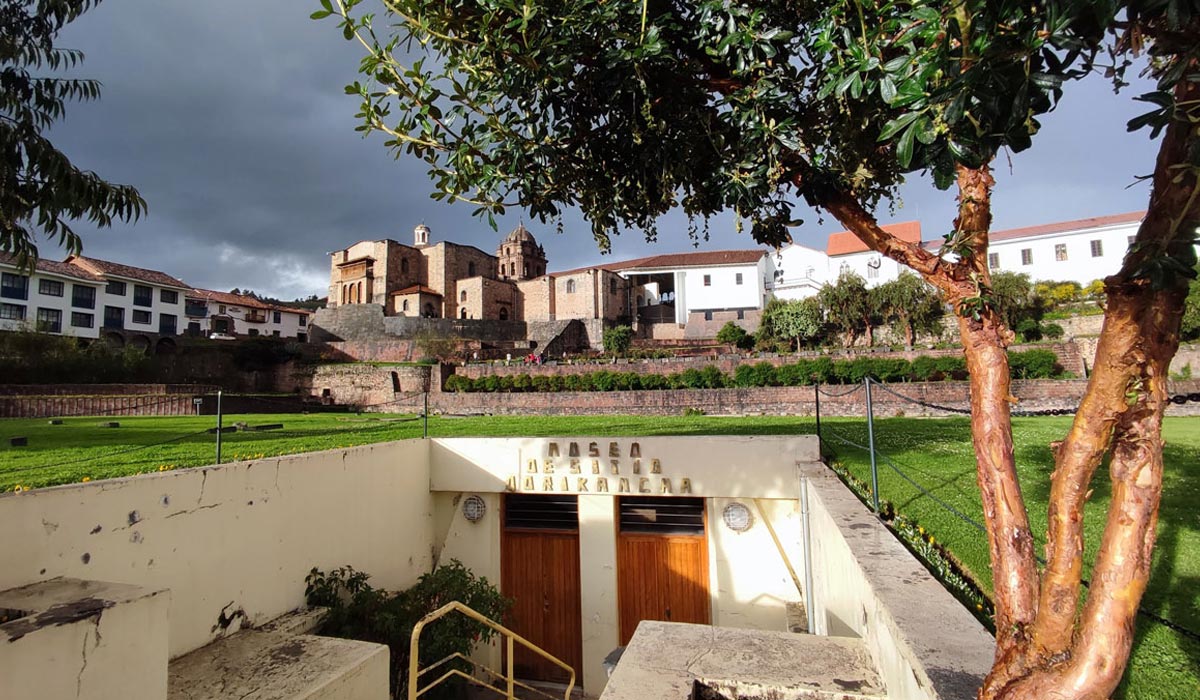
As a result of the excavations done around the sanctuary, the Qoricancha Site Museum was created to preserve and show the archaeological findings recovered during that work. The museum occupies an underground space divided into five rooms where you can see pottery pieces, tools from that time, and bone remains, along with information panels that go over the history of the Inca civilization from its origins to the conquest.
Location
The museum is right below the green area esplanade of the archaeological complex, at 526 El Sol Avenue. You can get there by walking from the Main Square, going down a few blocks in a straight line on the same avenue, without any complications.
Entry and hours
Unlike the temple, entry to the museum is included in the Cusco Tourist Ticket, which costs 70 soles (about 22 dollars) and also gives access to other sites in the city such as the Regional Historical Museum, the Contemporary Art Museum, the Pachacutec Monument, the Popular Art Museum, the Qosqo Native Art Center, and the Tipon and Piquillacta archaeological parks.
The museum is open every day from 9:00 a.m. to 6:00 p.m. The maximum time you can stay inside is one hour, a time that also includes access to the upper esplanade of the temple.
What you can see
The collection includes a variety of objects that give a very complete picture of Inca life and culture:
- Utility pottery pieces
- Keros, the Andean ceremonial cups
- Carved stone tools
- Ornaments made with seashells
- Mummies of the Inca elite
- Textile cloaks with geometric patterns
- Bone remains in good condition
- Carved wood tools
- Ponchos woven in alpaca wool
Frequently asked questions about the Qoricancha
- Is the Qoricancha the most important temple of the Incas?
Yes. It was the most important religious center of all the Tahuantinsuyo, with a spiritual importance that even surpassed Machu Picchu. - What was its main function?
It was first of all a worship center where the Inca elite paid respect to the main deities of the Andean world: the earth, the mountains, the moon, and the stars. But the central purpose of the site revolved around the Sun god, Inti, the supreme god of the Empire. - Where is it exactly?
Right in the center of Cusco, about 600 meters from the Main Square. You can get there walking without difficulty from any point in the historic center. - Is it true that the temple was full of gold?
Completely. The chronicles document that several sectors, including the main altar, were covered with pure gold sheets. The complex also kept pieces made of silver and precious stones, all of which was stolen by the Spanish conquerors during the 16th century. - Was the Inti Raymi celebrated here?
Yes. Historical records confirm that the great festival in honor of the Sun was held on the esplanade of the temple. That tradition is still alive today: every June 24, the people of Cusco celebrate Inti Raymi in honor of their ancestors. - Can you hire a guide on site?
Yes, there are guides available at the entrance of the site. You can choose to join a shared group with other visitors or hire a private tour, ideal for couples, families, or small groups. - Can you visit the Qoricancha as part of a tour?
Yes. The Cusco City Tour includes the Qoricancha along with the Cathedral, Sacsayhuaman, Qenqo, Puca Pukara, and Tambomachay, with transport, professional guide, and tickets included. It is the most complete option for anyone who wants to make good use of their time in the city.