
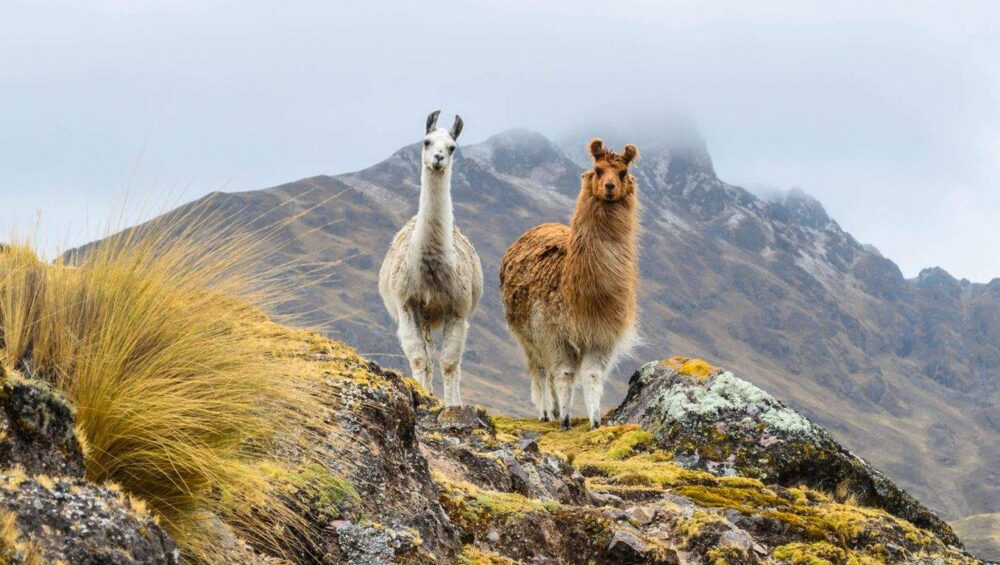
If you have seen a single postcard of Peru, you probably already know one of them: an animal with a long neck, a curious gaze, and a somewhat mischievous expression posing in front of the terraces of Machu Picchu. What almost no one knows is that this animal could be a llama, an alpaca, or even a more elusive relative that local guides barely mention. The four South American camelids share ancestors, habitat, and even physical traits so similar that the average traveler ends up calling them all “llamas.” And yet, the question almost every visitor asks in front of a pen at a Cusco market is the same: how do you tell a llama apart from an alpaca?
The confusion is understandable, but solving it opens a fascinating door into Andean culture. Each species played a different role for centuries: some carried goods along high-altitude paths, while others provided fibers so fine they became a symbol of power. Perhaps you have come across a “100% vicuña” label in a Cusco shop and wondered why it costs so much, or how weavers from Quechua communities turn that fiber into unique garments. From the landscape, the altitude, and the herds that inhabit it, the flora and fauna of Machu Picchu reveal an ecosystem where these animals remain part of daily life, as present today as in the times of Tahuantinsuyo. And then another question arises: why did only Inca royalty wear vicuña?
In this guide, you will find everything you need to stop confusing them. We compare the alpaca, llama, vicuna, and guanaco in size, appearance, behavior, habitat, and fiber quality, with practical tips to recognize them in the field. We also explore their role in Inca and Andean culture, the difference between their fibers, and what lies behind an authentic Andean textile, so you can make a better choice when buying. In the end, you will know what animal is in front of you, what wool you are wearing, and how much history is in every thread.
Getting to know South American camelids
The four animals in this guide belong to the same family, South American camelids, and are divided into two groups according to their relationship with humans. The llama and the alpaca are domestic: they have lived alongside Andean communities for millennia, raised in herds for their fiber, carrying capacity, and meat. The vicuña and the guanaco are wild: they live free in the puna and other high-altitude landscapes, and have never been domesticated. However, each domestic species keeps a direct link to a wild one, because they descend from it.
That link is the key to understanding everything else. The llama descends from the guanaco, a sturdy and large animal that adapts to very different environments, from the Andean heights to Patagonia. The alpaca, on the other hand, comes from the vicuña, the smallest, most slender, and most delicate of the four, famous for its ultra-fine fiber and for living above 4,000 meters. Andean peoples began this domestication process about 6,000 or 7,000 years ago, selecting the most docile individuals with the best fiber over generations. Thus, the guanaco became the pack animal that crossed mountain ranges, and the vicuña became the alpaca with an abundant and soft fleece.
This relationship between humans and camelids sustained entire civilizations. During the height of Tahuantinsuyo, herds were a state resource: llamas transported goods along the road network, alpacas provided wool for ceremonial and everyday textiles, and the vicuña was kept under special protection. Understanding what each animal is and where it comes from is, at its core, understanding how life was organized in the Andes. In the following sections, we will see how to recognize each one one by one.
Llama vs. alpaca vs. Vicuña vs. Guanaco: how to tell them apart?
Although at first glance they look alike, each of the four camelids has its own traits in size, face, ears, and fleece. The basic rule is simple: llama and alpaca are the domestic species, and vicuña and guanaco are the wild ones. With that in mind, let us review the specific features of each one.
The llama: The Andean pack animal
The llama is the largest of the domestic camelids. It measures about 1.20 meters to the withers (shoulder height) and can exceed 1.70 meters if counting its raised head, with a weight usually around 130 to 200 kilos. It has a long face, a more prominent snout, and long ears curved inward, often described as “banana-shaped.” Its neck and legs are long, and its face and limbs are usually almost free of wool.
Its fleece is rougher and less uniform than that of the alpaca, with a mix of coarse and fine fibers, so it is used for sturdier items like blankets, ropes, sacks, and rugs rather than fine clothing. Its main use is carrying loads: an adult llama can carry between 20% and 25% of its weight over long distances across mountain terrain. In addition, it provides fiber, meat (widely consumed in high-Andean communities), and even dung as fuel and fertilizer. It lives in the high plains and Andean valleys of Peru, Bolivia, northern Chile and Argentina, and Ecuador, generally between 2,300 and 4,000 meters in altitude.
The alpaca: The soft fiber of the altiplano
The alpaca is smaller and more compact than the llama: it measures around 90 centimeters at the withers and weighs between 50 and 80 kilos. Its face is short and rounded, with a flatter snout and an almost flat expression, and its ears are short, straight, and pointed, like small spears. Its body looks fluffier because the fleece covers a good part of its face, neck, and legs.
That fleece is precisely its great virtue: it is finer, softer, and more uniform than that of the llama, and there are more than twenty natural shades, from white to black, passing through beige, brown, and gray. That is why it is raised mainly for its fiber, which is sheared once a year, and not as a pack animal.
How to distinguish it from the llama?
If you wonder how to tell a llama apart from an alpaca, look at three things:
- Size (the llama is clearly larger)
- Ears (long and curved in the llama, short and straight in the alpaca)
- Face (long in the llama, rounded and covered in wool in the alpaca)
An extra clue: If the animal is carrying a load or looks tall and thin, it is almost certainly a llama; if it looks bulky, with dense fur and a teddy-bear face, it is an alpaca. It is the point that confuses travelers the most, and with these clues, it is solved in seconds.
Alpacas live in the altiplano of southern Peru and Bolivia, especially in regions like Cusco, Puno and Arequipa, at altitudes between 3,500 and 5,000 meters, where wet pastures (bofedales) sustain their herds. Peru concentrates the vast majority of the world’s population of this species.
The vicuna: National symbol and the finest fiber
The vicuna is the smallest and most slender of the four: it measures about 80 to 90 centimeters at the withers and weighs barely between 35 and 65 kilos. Its body is graceful, with thin legs and a long neck, with a cinnamon-colored coat on its back and white on its chest and belly, where a very characteristic tuft of long hair hangs down. Its face is small and delicate, and its ears are short and upright.
Its fiber is considered the finest and most expensive in the world, with a diameter of just 12 to 14 microns, and it can only be sheared every two or three years, from animals captured temporarily and then returned to their habitat. Its fiber also had high value for the Incas: during Tahuantinsuyo, vicuña garments were reserved for Inca royalty and the elite, and the herds were protected by the State and sheared in ceremonies called chaccu. Today, that tradition remains alive in high-Andean communities.
Did you know…? The vicuña is a national symbol of Peru: it appears on the national coat of arms, where it occupies the upper left quadrant as an emblem of the country’s fauna, alongside the cinchona tree (flora) and the cornucopia (mineral wealth).
It inhabits the high puna, between 3,500 and 5,500 meters, in Peru, Bolivia, Chile, and Argentina. In Peru, a large part of the population is found in the Pampa Galeras Barbara D’Achille National Reserve, in Ayacucho, one of the main conservation areas for the species.
The guanaco: The wild ancestor of the llama
The guanaco is the wild ancestor of the llama, and it looks quite similar to it, though it is somewhat more slender, with short cinnamon-colored fur, a white belly, and a grayish face with long, upright ears. It measures about 1.10 to 1.20 meters at the withers and can weigh between 90 and 140 kilos. Compared to the llama, it stands out for that dark face and its wilder, more athletic look, as it has never been bred for carrying loads.
It is the most widely distributed wild camelid: it reaches from southern Peru to Patagonia and Tierra del Fuego. In Peru it is less common than in the south of the continent, and its small populations are concentrated in southern areas of the country, such as Arequipa, Moquegua, Tacna, and Ayacucho, while Chile and Argentina hold the largest populations.
Final comparison table
This table summarizes the differences between the four species:
| Feature | Llama | Alpaca | Vicuña | Guanaco |
|---|---|---|---|---|
| Status | Domestic | Domestic | Wild | Wild |
| Shoulder height | ~1.10–1.20 m | ~0.90 m | ~0.80–0.90 m | ~1.10–1.20 m |
| Approximate weight | 130–200 kg | 50–80 kg | 35–65 kg | 90–140 kg |
| Face and ears | Elongated face; long and curved ears | Short and rounded face; short and straight ears | Small and fine face; short and upright ears | Grayish face; long and upright ears |
| Fleece | Coarser and less uniform | Fine, soft, and uniform | The finest in the world | Short, cinnamon-toned |
| Main use | Pack animal, fiber, and meat | Fiber | Fiber (shearing of wild animals) | No domestic use |
| Ancestor | Guanaco | Vicuña | Wild (ancestor of the alpaca) | Wild (ancestor of the llama) |
| Habitat | Altiplano and Andean valleys (2,300–4,000 m) | Southern Peruvian and Bolivian Altiplano (3,500–5,000 m) | High puna (3,500–5,500 m) | From southern Peru to Patagonia |
Where to see llamas, alpacas, and vicunas in Peru
The first encounter with these animals usually happens in Cusco and Machu Picchu. At the Inca citadel, llamas graze on the terraces and pose for thousands of cameras every day, and around Cusco it is common to run into women dressed in traditional outfits walking alpacas and llamas through the squares. These are very photogenic scenes, but to see the camelids in their most natural environment, it is best to go up to the high-altitude routes, where herds are part of the landscape and the daily life of the communities.
One of the best options is the Ausangate Trek, which circles the sacred mountain at over 4,000 meters and crosses grasslands where alpacas and llamas graze, with vicuñas appearing in the distance in the highest zones. More accessible is Palccoyo, a short walk to the famous rainbow mountain, where local communities raise their herds along the trail. To the south, in Arequipa, the Colca Canyon combines landscapes of vicuñas in the Salinas and Aguada Blanca reserve with agricultural terraces and viewpoints where the Andean condor soars through the sky in the early morning hours. And on the Puno altiplano, beside Lake Titicaca, alpacas and llamas are common in the communities surrounding its shores.
One last recommendation: Keep a safe distance, avoid chasing them or touching them without the breeder’s permission, and do not feed them, as human food harms them. Vicuñas, moreover, are wild and very sensitive animals; observe them from afar and quietly.
Andean fibers and textiles
For millennia, camelid fiber was the raw material of Andean life: it kept people warm from the cold of the puna, served as ceremonial currency and tribute, and allowed communities to develop a textile tradition that endures to this day. Each species provides something different: the alpaca offers a soft, warm fiber in many natural colors; the llama, a thicker and sturdier fiber; and the vicuña, the finest and scarcest of all. If you want to review those differences at a glance, go back to the comparison table in the previous section. Let us now see how that fiber turns into a textile.
From shearing to the loom
The artisanal process follows steps passed down from generation to generation:
- Shearing. The fleece is cut once a year in the case of the alpaca and llama, normally in the dry season, and every two or three years for the vicuña.
- Spinning. The fiber is cleaned, sorted, and stretched until it forms yarn, traditionally with a hand spindle (puska), a task many weavers do even while walking or herding.
- Skeining. The yarn is wound into skeins, ready to be dyed easily.
- Dyeing. The skeins are dipped into color baths, with natural dyes or, increasingly, industrial ones.
- Warping. The lengthwise threads (the warp) are prepared, which will be stretched tight on the loom and hold the design.
- Weaving. The crosswise threads (the weft) are interlaced with the warp threads to form the cloth and its patterns.
- Finishing. The edges are trimmed, the piece is washed and smoothed, and fringes or seams are added if needed.
Two techniques stand out in Andean weaving. The backstrap loom is the most traditional; one end is tied to a tree or post and the other to the weaver’s waist, who regulates tension with their own body. It allows narrow pieces with very elaborate designs, such as belts, blankets, and ponchos. Tapestry, on the other hand, is a technique in which the weft completely covers the warp and images are formed more freely, so it looks like a woven painting. It is widely used in decorative pieces.
Natural dyes and design symbolism
The colors of Andean textiles come from plants, insects, and minerals of the region. Among the most used are:
- Cochineal, an insect that lives on prickly pear cacti and yields intense reds, maroons, and pinks.
- Q’olle and chilca, plants that yield yellows and greens.
- Walnut (tara), whose bark and leaves produce browns and grays.
- Indigo, the traditional source of blues.
- Mordants, such as salt, fermented urine, or minerals like alum, which help fix the color.
The designs (pallay) work as a visual language: they represent mountains, rivers, plants, animals, the agricultural cycle, and the worldview of each community. Zigzag lines can evoke water, stepped shapes recall terraces, and motifs of flowers, birds, or felines allude to local wildlife. The motifs vary from one community to another because each developed its own codes over time, tied to its territory, customs, and identity. In fact, an experienced weaver can recognize where a piece comes from just by its colors and iconography.
How to recognize an authentic garment
Buying an alpaca garment in Cusco or Puno can be puzzling, because the supply is huge and not always honest. These guidelines help you choose better.
What “baby alpaca” means and how to read the label. “Baby alpaca” does not refer to the age of the animal, but to the fineness of the fiber: it is a quality grade, with fibers of around 22.5 microns or less. It usually refers to the softest fiber of the fleece and is used in higher quality garments. On the label, look for the composition percentage (“100% alpaca”, “70% alpaca, 30% wool”) and distrust vague terms like “alpaca type”, “alpaca style”, or “alpaca blend” without numbers. It is also good for the origin of the garment to be listed.
Clues in feel and composition. Authentic alpaca feels soft, warm, and light, without the roughness of sheep’s wool or the plastic shine of acrylic. Rub the garment between your fingers: if it generates static electricity, smells like plastic, or loses its shape easily, it probably contains synthetic fibers. A classic test is to carefully bring a loose strand close to a flame: animal fiber burns slowly and smells like burnt hair, while acrylic melts and smells like chemicals. Do this only with the seller’s permission and with caution.
What to expect from the price. A good quality, handwoven alpaca garment has a cost that reflects hours of work and selected fiber. Therefore, a sweater or poncho at a very low price should raise doubts: most likely it mixes in acrylic or other fibers. Vicuña pieces, furthermore, are extremely expensive and must come with official certification of origin. If someone offers you a “vicuña scarf” for a few soles, it is almost certainly not vicuña.
Where to learn about and buy authentic textiles?
Centers and communities
To understand a textile before buying it, the best thing is to see how it is made. Right in the center of Cusco, the Center for Traditional Textiles of Cusco (Av. El Sol, next to Qoricancha) works with weaving communities of the region. There, the spinning, dyeing, and weaving processes are shown, and pieces are sold with information about their origin and the community that made them. It is a good first step to learn to recognize quality before heading out to the markets.
If you want to see the craft in its setting, the Sacred Valley of the Incas brings together several communities that open their workshops to visitors. In Chinchero, weavers give demonstrations ranging from washing wool with plants to dyeing and weaving on the loom, and sharing that process explains why each piece has a different price. Further in, in communities like Patacancha and Huilloc, near Ollantaytambo, weaving remains a daily activity and designs retain very distinct traits. There, purchases are made directly from the weavers, ensuring the income reaches the families.
Markets and buying tips
Markets are the place to compare and bargain calmly. The Pisac market is one of the best known in the Sacred Valley, with a wide selection of sweaters, blankets, and scarves, and it gets especially lively on Sundays. The Sunday market in Chinchero has a more local atmosphere, with bartering still present among communities and stalls of weavers selling their own pieces. In Ollantaytambo, the streets next to the square and the train station concentrate craft and textile stalls, ideal for a quiet purchase before or after visiting the fortress.
To buy responsibly, keep these guidelines in mind:
- Compare before deciding. Walk around several stalls and shops to understand the difference between a handwoven piece and a machine-made one.
- Ask about the origin. The person who weaves can usually tell you which community the design is from and how long the piece took.
- Apply what you learned. Check the label, feel, and composition, as we saw in the previous section.
- Bargain with respect. A polite discount is normal, but pushing for a rock-bottom price punishes the weaver’s work.
- Prefer buying directly from communities or artisans’ associations, so the money reaches the person who made the piece.
- Bring cash in soles and small bills, because many stalls and communities do not take cards.
Frequently asked questions
- Do llamas and alpacas spit?
Yes, although they do not do it on a whim or against visitors. Spitting is their way of setting boundaries with other members of the herd, for example when fighting over food or space. What they project is usually a mix of saliva and stomach contents, and they rarely aim it at a person. If you keep your distance, do not bother them, and avoid surrounding or cornering them, it is very unlikely they will hit you. - Can they be touched or fed?
With llamas and alpacas in the communities, it depends on the breeder: ask before approaching and respect their answer. They do not usually enjoy having their head or neck touched, so if you are given permission, it is best to pet them gently on the back. Feeding them human food is not recommended, because it can make them sick. Vicuñas and guanacos are wild, so the right thing to do is observe them from afar and quietly. - What is the difference between alpaca and baby alpaca?
“Alpaca” is the name of the animal and the fiber in general, while “baby alpaca” is a grade of fineness. It does not refer to a baby animal, but to a thinner and softer fiber, which usually comes from the finest areas of the fleece. That is why baby alpaca garments are softer and generally more expensive than regular alpaca ones. - Can you buy vicuña garments?
Yes, but with conditions. Since it is a protected species, legal fiber comes from live animals that are temporarily captured, sheared, and returned to their habitat. Authentic garments are very scarce and expensive, and must be accompanied by official certification of origin. If the price is very low or there is no documentation backing the piece, it is most likely not vicuña. - Do people eat alpaca meat in Peru?
Yes. Alpaca meat has been eaten for centuries in high-Andean communities and today also appears in restaurants in Cusco and other cities, in dishes such as tenderloin, skewers, or stews. It is a lean meat with a mild flavor, similar to other light red meats. If you are interested in trying it, it is one more way to get closer to Andean gastronomy. - How do I know if a textile is authentic?
Combine three clues: the label, the feel, and the price. Look for a clear composition percentage (for example, “100% alpaca”) and distrust expressions like “alpaca type” or “alpaca style”. Authentic fiber feels soft, warm, and light, with no plastic shine or static electricity. And if the price is surprisingly low, there is probably acrylic in the blend. Buying directly from communities or weavers’ associations is the safest way to be sure of what you are getting.