
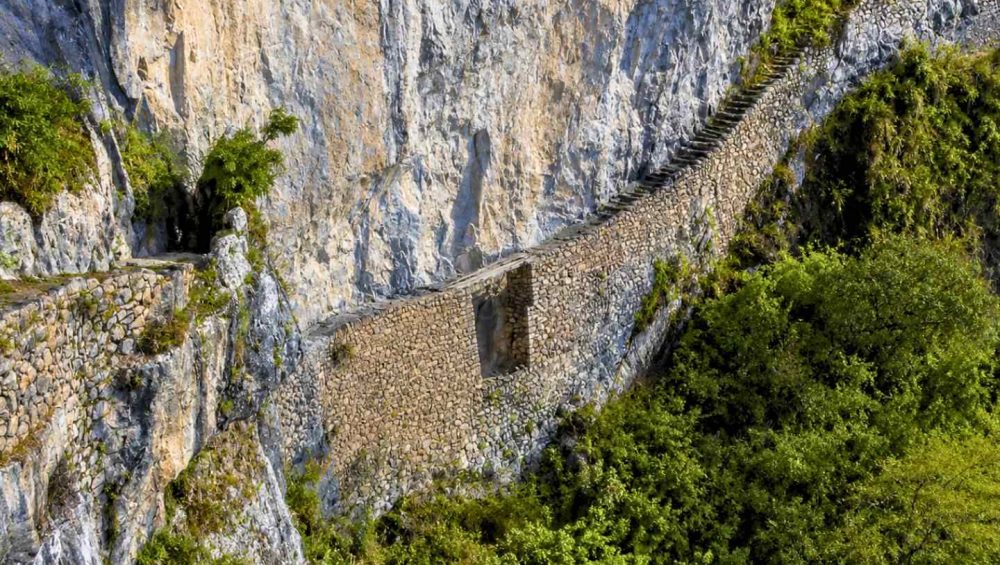
Machu Picchu is, without a doubt, one of the most visited destinations in the world. However, within its own borders, there is a corner that most tourists never get to see: the Inca Bridge. And that, interestingly, is part of its charm.
Located at the western end of the Inca citadel, this wood and stone bridge does not appear in the most famous postcards or in the most popular tourist circuits. To reach it, you have to walk about 20 minutes from the Guardian’s House, following an original stone path from the Inca times, between cliffs and wide views. Those who make this effort, which is actually minimal, find one of the most clever and best-kept buildings of the entire citadel.
But the Inca Bridge is not just a pretty structure to photograph. It is a key piece in the history of Machu Picchu: it was an alternative entry route to the citadel, a defense mechanism against possible invaders, and a connection point with the vast network of roads that the Incas built across the entire continent. In short, this bridge had as much strategic as symbolic weight in the Inca empire.
If you are planning your visit to Machu Picchu and want to go beyond the normal experience, the Inca Bridge is exactly the kind of place you are looking for. In this guide, you will find everything you need to know to organize it: from how to get the right ticket to what to carry in your backpack, going through the schedules, the route, and the best tips so the visit is worth every step.
History and function of the Inca Bridge
If there is one thing that defines Inca architecture, it is that they never built anything without a reason. Every stone, every road, every structure had a clear purpose, and the Inca Bridge of Machu Picchu is no exception. Behind its apparent simplicity hides a history of military strategy, territorial control, and connection with one of the most impressive road systems the world has ever known.
Defensive and strategic role
To understand the function of the Inca Bridge, you have to imagine Machu Picchu as it was: a citadel with controlled access, located high on a mountain and surrounded by natural cliffs. Its builders knew that geography was their best ally, and they made the most of it.
The citadel had two main access routes. The most known was the Inca Trail, which went around the eastern side of the mountain and is the one visitors use today. The second was an alternative route on the western side, much more discreet: that is exactly where the Inca Bridge was built.
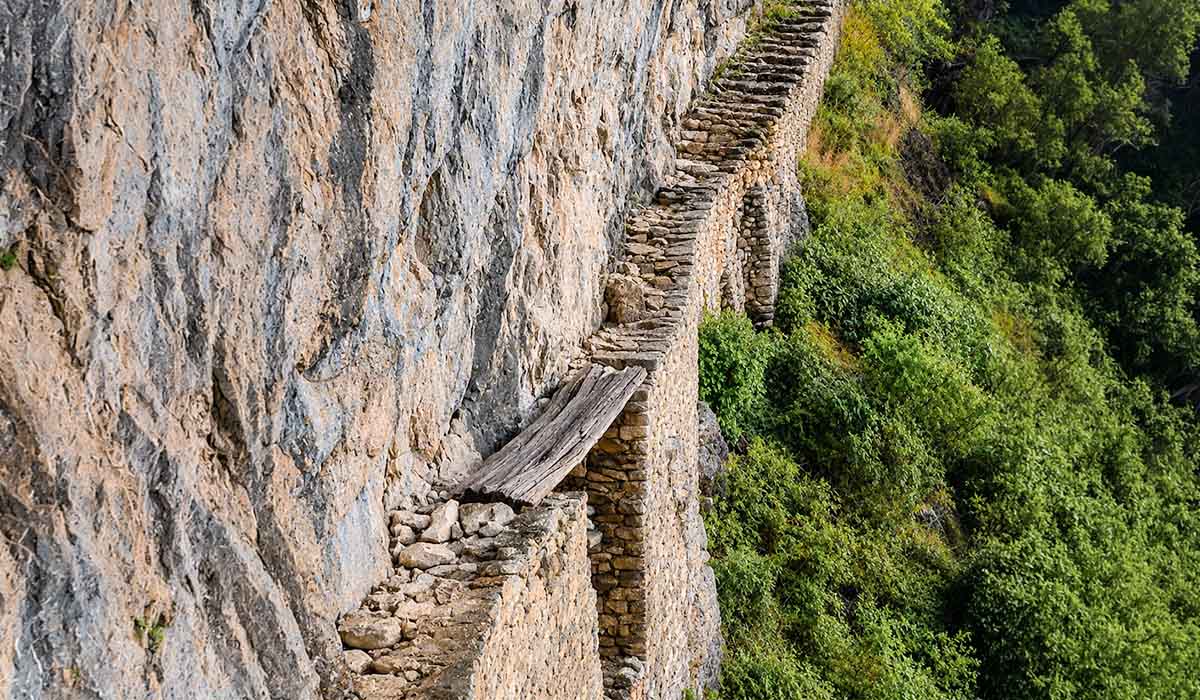
This bridge, made of thick wooden logs held between two stone walls, had a design as simple as it was brilliant. In case any enemy group tried to enter through that route, the Inca guards simply removed the logs from the bridge. Immediately, the passage became impossible to cross: without the wood, there was only a 20 meter cliff over the void and a vertical rock wall with no possible way out. An effective defense system, with no need for large armies or weapons.
Connection with the Qhapac Ñan (Inca Trail)
The trail that leads from Machu Picchu to the bridge is not just any road. It is part of the Qhapac Ñan, also known as the Inca Trail, one of the most ambitious engineering works in pre-Columbian America.
The Qhapac Ñan was a network of roads that stretched for more than 60,000 kilometers, crossing what are now several South American countries: Peru, Ecuador, Colombia, Bolivia, Chile and Argentina. This network not only connected important cities of the Inca Empire, but also small tambos (a kind of inns or resting points), ceremonial places, administrative centers and sacred sites throughout the region.
Walking today along the trail that leads to the Inca Bridge is, in a way, stepping on the same stones that messengers, soldiers, and pilgrims stepped on more than 500 years ago. The original Inca stone pavement is kept in much of the route, which makes this walk more than just a tourist tour: it is a direct contact with the living history of the Tawantinsuyu. In 2014, the Qhapac Ñan was declared a World Heritage Site by UNESCO, a recognition that speaks for itself of its historical and cultural value.
Physical and architectural features
When one arrives for the first time at the Inca Bridge and sees it in person, the first reaction might be of surprise. It is not a huge or decorated structure. It does not have the visual drama of the Temple of the Sun or the imposing scale of the agricultural terraces. It is, in appearance, something almost modest: some wooden logs between two stone columns, at the edge of a cliff. But it is exactly that simplicity that hides the true Inca genius: doing a lot with a little, in the right place and in the right way.
- Inca construction materials and technique: Log bridges were the most basic type within the wide range of Inca engineering, but that did not make them less effective. Their construction followed a clear and tested process: first, the logs were laid horizontally on two firm support points, usually natural rocks or stone walls built for that purpose. Then, cross sticks were placed over the main logs, which were tied with braided straw or leather wool ropes, strong materials available in the region. Finally, branches were placed on top of the framework to create a more stable and even walking surface.
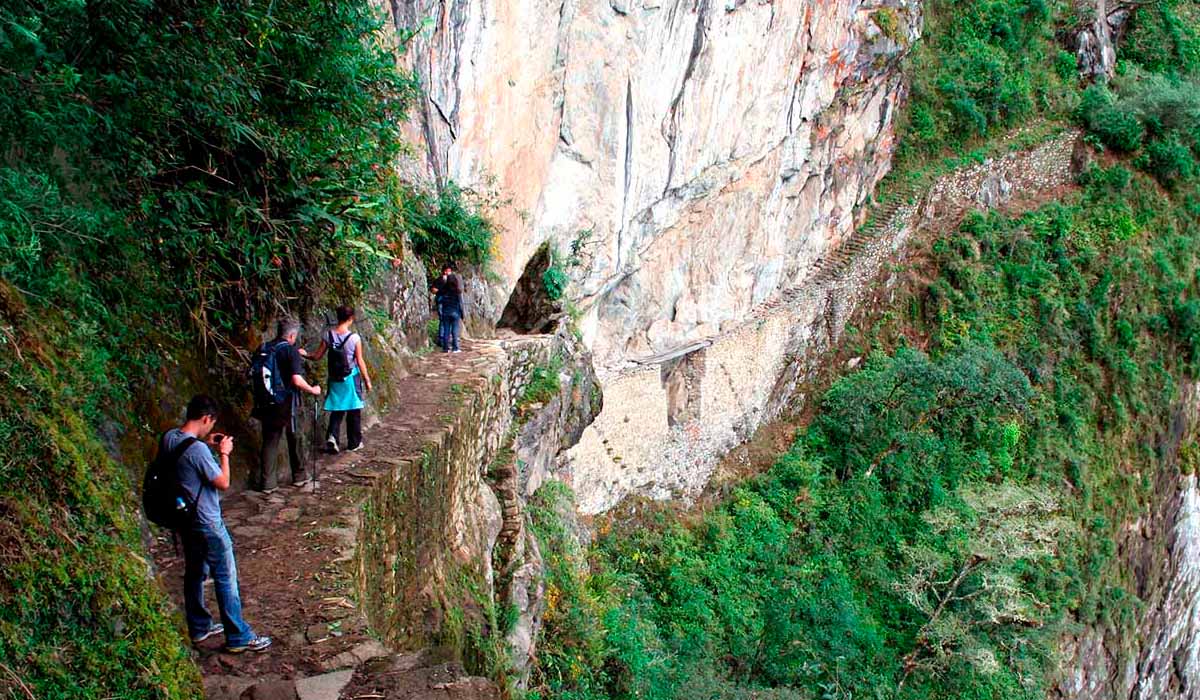
- Dimensions and geographic environment: The bridge itself has an approximate length of 5 meters, held by the logs that cross the space between the two stone columns. Under those logs, the ground falls sharply into a cliff about 20 meters deep. The geographic environment surrounding the bridge is equally impressive. The trail leading to it runs along the western face of the Machu Picchu mountain, an area known for almost vertical rock walls, thick vegetation, and panoramic views of the valleys and mountains that stretch in all directions. In some sections, the path is barely wide enough for one person, with the rock wall on one side and the void on the other.
- Current state and crossing restrictions: Today, the Inca Bridge can be visited and admired, but not crossed. The natural decay of the wooden logs over the centuries has made the structure unsafe for traffic, so authorities have strictly banned walking over the bridge. This restriction, far from being a disappointment, invites a slower contemplation. Without the chance to cross to the other side, the focus shifts to the details: the texture of the carved stone, the precision of the walls, the way the bridge blends with the natural rock of the mountain.
How to get to the Inca Bridge
One of the great advantages of the Inca Bridge is that you do not need to be an experienced hiker to reach it. The route is short, accessible, and, for the most part, follows an original stone path from the Inca era that has its own historical value.
The tour to the Inca Bridge begins on the upper platform of Machu Picchu, specifically from the sector known as The Guardian’s House. This is one of the most recognizable points of the entire citadel. From The Guardian’s House, the path to the Inca Bridge covers about 1 kilometer in a single direction. The route is linear, without forks that could create confusion, which makes it especially friendly for those who are not familiar with the terrain.
The trail combines wide sections with others that are much narrower, where the path narrows to just the width for one person. The total walking time from The Guardian’s House to the bridge is about 20 to 30 minutes one way. The return follows the same route, so the complete tour takes around 45 minutes to 1 hour, depending on your pace and stops to take photos.
Guide map of the tour
To guide you better, this is the general outline of the complete tour from the moment you enter the archaeological site:
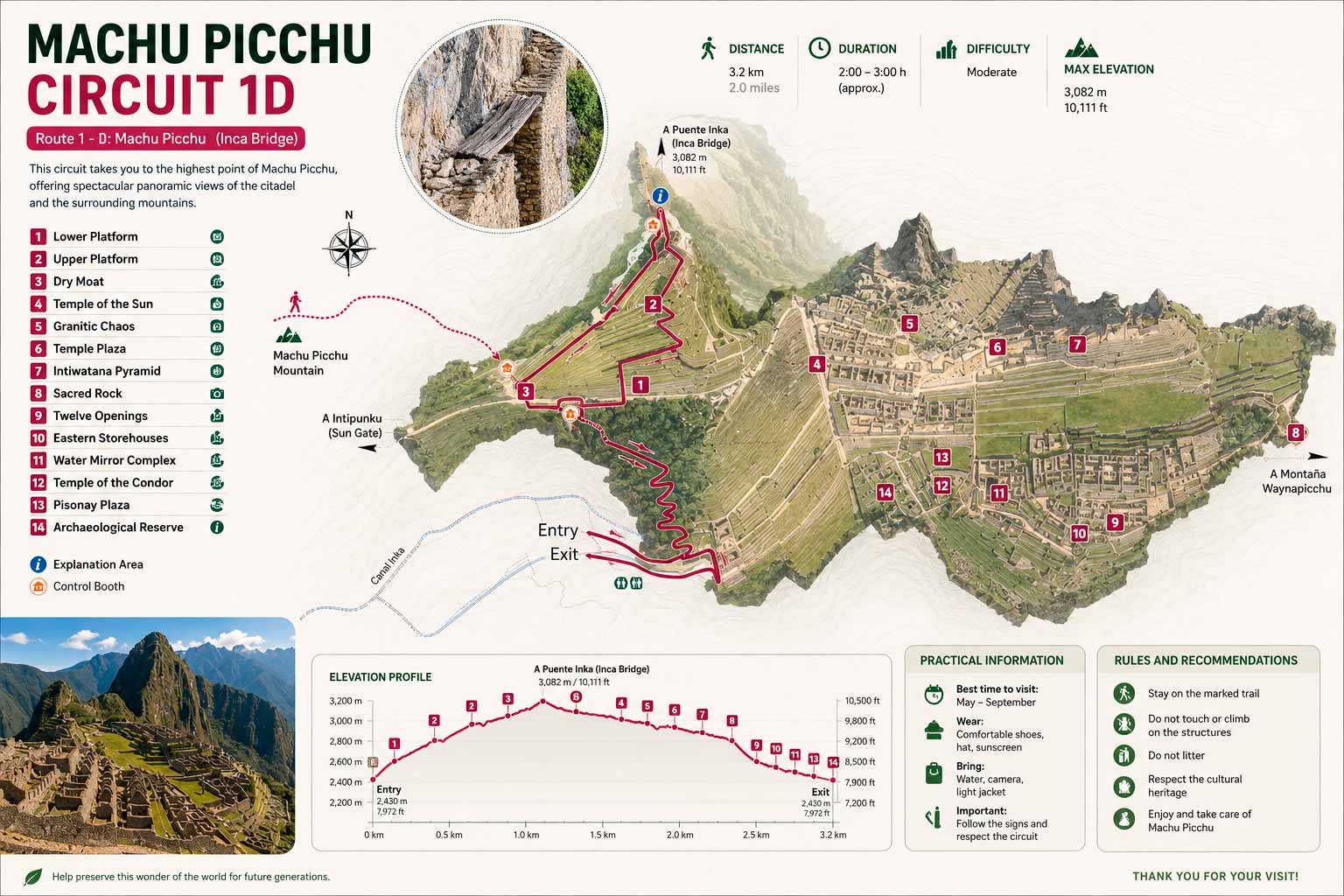
The total time spent, counting the climb from the entrance to the upper platform and the round trip to the bridge, is about 1 hour and 30 minutes. The authorities give a maximum time of 3 hours to complete the entire circuit, which leaves enough room to walk without rushing, stop to look, and take pictures at the highlights of the trail.
Planning the visit
Visiting the Inca Bridge requires a bit more planning than a standard entry to Machu Picchu. It is not enough to arrive and decide at the moment: there is a specific ticket, enabled seasons, and entry times that you must know in advance to avoid surprises. Here is everything you need to organize before arriving.
- Necessary ticket (Circut 1D: Machu Picchu + Inca Bridge): The only ticket that allows access to the Inca Bridge is the one that combines the general entry to Machu Picchu with this specific attraction: Circuit 1D (Machu Picchu + Inca Bridge). It is not possible to enter the bridge sector with a standard entry to the citadel or add this tour in an improvised way once inside.
- Where and when to book: Reservations for the Circuit 1D ticket are made through the official Machu Picchu pages or at authorized travel agencies. There are no physical sales points at the archaeological site, so trying to get a ticket the same day of the visit, without a prior reservation, is not a viable option. Regarding the recommended advance notice, the ideal is to make the reservation at least one month in advance.
- Enabled season (from June 1 to October 15): This is one of the most important details and one that many travelers do not know: the tour to the Inca Bridge is only enabled during the official high season of Machu Picchu, which goes from June 1 to October 15 of each year. Outside this period, access to the bridge sector remains closed.
- Available schedules by groups: The entry to the Inca Bridge sector is organized into four time groups, each with a 45 minute window to start the tour: Group 1 (8:00 to 8:45 am), Group 2 (9:00 to 9:45 am), Group 3 (9:00 to 9:45 am), Group 4 (11:00 to 11:45 am). Once inside the assigned schedule, the total time allowed to complete the circuit is 3 hours, a margin more than enough to enjoy the tour without rushing.
The experience on the trail
One of the best news about the Inca Bridge is that it does not require any special physical condition. The hike from the Guardian’s House to the bridge covers approximately 1 kilometer in each direction, with an estimated time of 20 to 30 minutes one way. The complete round trip takes about 45 minutes, although with stops to take photos and contemplate the landscape it can extend up to 1 hour without a problem.
The difficulty level is low. The trail does not have steep slopes or require significant effort. The only moments that need a bit more attention are the narrow sections next to the cliffs, where the path narrows considerably. At those points, it is enough to move slowly, step carefully on the cobblestones, and stay away from the edge.
What to see during the tour?
The trail itself is already part of the experience. From the moment you leave the citadel, the landscape changes notably. The vegetation becomes thicker, the sounds of the crowd disappear and the environment takes on an almost contemplative quality that is rarely found in Machu Picchu.
Along the trail, you can see sections of the cobblestone path, privileged views toward the valleys and mountains that surround the citadel, and a completely different perspective of the Machu Picchu mountain, seen from its western face.
Practical tips and equipment
Although it is a short hike, there are some basic items that make the difference between a comfortable visit and an unnecessarily uncomfortable one:
- Footwear: It is the most important item. Choose sneakers or boots with good grip soles. The Inca cobblestones can be slippery, especially if there is humidity, and the narrow sections require a firm and secure step.
- Water: Always bring a bottle, even if the route is short. The altitude of Machu Picchu speeds up dehydration and it is easy to underestimate it.
- Sunscreen: The sun in the Peruvian highlands is intense even on cloudy days. Apply it before leaving and take the bottle to reapply during the tour.
- Mosquito repellent: Especially useful in the sections closest to the jungle vegetation.
- Waterproof poncho: Regardless of the time of year, the weather in Machu Picchu can change quickly. A light poncho barely takes up space in the backpack and can save you from an unexpected downpour.
Safety rules on the cliffs
The trail is safe, but the environment demands respect. Some points of the route run very close to cliffs without railings, so it is best to follow these basic recommendations: always keep a safe distance from the edge, avoid leaning out or leaning over to take pictures in risky areas, move slowly in narrow sections and calmly give way when the path does not have space for two people at the same time.
Prohibitions and restrictions to keep in mind
The Circuit 1D ticket (Machu Picchu + Inca Bridge) only enables the specific circuit of this tour. During the visit, it is not allowed to detour to other sectors like Intipunku or the Machu Picchu Mountain, access restricted areas outside the marked trail, or cross the bridge. Upon entering the Inca Bridge sector, it is mandatory to register your entry and exit for security reasons, a simple process that takes just a moment.
How to combine the visit with other attractions
The most natural and recommended combination is the Inca Bridge along with Circuit 2 of Machu Picchu, also known as the Classic Route. This circuit tours the most iconic sectors of the citadel: the Temple of the Sun, the Sacred Plaza, the Intihuatana, and the agricultural terraces, among other points. Its approximate duration is 2 hours and 30 minutes, with schedules available from 6:00 in the morning.
The most efficient strategy is to do Circuit 2 first early in the morning and then head to the Inca Bridge during the Group 2 or 3 schedule. This way you use the morning to contemplate the citadel and you arrive at the bridge when the general flow of tourists has already passed its highest peak.
-
Intipunku (Sun Gate) as a complementary alternative
If the Inca Bridge seems like too little for a full day of exploration, Intipunku is the most similar alternative in spirit: a tour away from the crowds, with an extraordinary visual reward upon arrival. The hike to the Sun Gate takes approximately 2 hours round trip from the citadel, with a more demanding climb than the Inca Bridge. From there you get a top view of all of Machu Picchu that few people get to see. Entry is included with any general ticket to the citadel, with no need for an extra ticket.
-
Recommendations according to the chosen schedule
The combination of attractions depends directly on the entry time to the Inca Bridge. As a general rule: groups 1 and 2 are ideal for combining the bridge with Circuit 2 on the same day, as they allow distributing the activities throughout the morning with plenty of time. Groups 3 and 4 work better if you first take a tour of the citadel and leave the Inca Bridge for the final part of the visit. In any case, spending the night in Aguas Calientes the night before is always the most comfortable decision and the one that opens up more combination possibilities.
Frequently asked questions
- Can the bridge be crossed?
No. Crossing the bridge is prohibited. Visitors can reach the observation platform and appreciate the structure from the front, but it is not allowed to step on it or try to cross to the other side. The restriction is for both personal safety and the preservation of historical heritage. - Are there age restrictions?
There are no age restrictions to visit the Inca Bridge. The tour is accessible for visitors of any age, as long as they have enough basic mobility to walk on cobblestone paths with some unevenness. In the case of small children or elderly people, it is recommended to move calmly, especially in the narrowest sections of the trail. - What happens if it rains?
Although the route is only enabled during the official dry season, occasional rains can happen even between June and October. In case of light rain, the trail becomes more slippery, so footwear with good grip and a waterproof poncho go from being recommended to essential. If the weather conditions are severe, the site authorities can temporarily suspend access to the sector for safety reasons. In that case, the decision is final and there is no possibility of rescheduling the ticket on the same day. - How to go up to the archaeological site from Aguas Calientes?
There are two options to go up from Aguas Calientes to the entrance of Machu Picchu. The first and most used are the eco-friendly buses, which leave frequently from the center of town, take approximately 30 minutes to reach the site, and run from the early hours of the morning. It is the most comfortable option, especially if you plan to do the Inca Bridge the same day. The second option is to go up on foot via the stairs route, a demanding climb of approximately 2 hours at a good pace that requires good physical condition and leaving with enough time before the reserved entry time.