
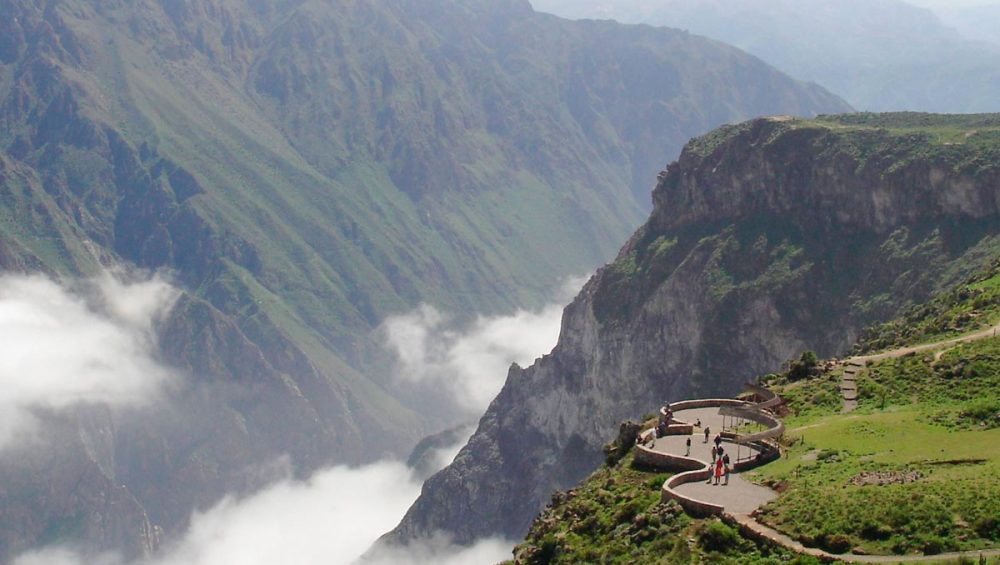
Did you know there is a canyon in southern Peru almost twice as deep as the Grand Canyon in Colorado? The Colca Canyon, in the Arequipa region, reaches depths between 3,270 and 3,400 meters in the section visited by most tourists, near the Cruz del Condor Viewpoint.
The Colca Canyon is not just a landform. Along its more than 70 kilometers of length, towns like Chivay, Yanque, Coporaque, and Maca coexist, where the Collagua and Cabana cultures maintain textile traditions, pre-Hispanic terracing architecture, and festivals that date back centuries before the arrival of the Spaniards.
In this article you will find everything needed to plan your visit to the Colca Canyon: how to get there from Arequipa, what the best time of the year to go is, what activities and towns you can visit, a suggested two-day itinerary, and practical data on altitude, prices, and what to bring.
What is the Colca Canyon? Data and mysteries of its formation
The Colca Canyon is a fracture in the Earth’s crust located in the Caylloma province, Arequipa region, formed by the combination of tectonic activity and the constant erosion of water over millions of years. It is not a canyon in the classic sense of narrow vertical walls: for much of its route it opens up as a wide valley, with slopes stepped by pre-Hispanic terraces, and only closes into a deep gorge in specific sections.
The origin of the Colca Canyon
The Arequipa region sits on a zone of intense volcanic activity, with snow-capped peaks like Ampato (6,300 m a.s.l.) marking the upper limit of the basin. That activity, combined with geological faults in the crust, generated the rugged terrain over which the Colca River carved its course for millions of years.
World records: How deep is the Colca?
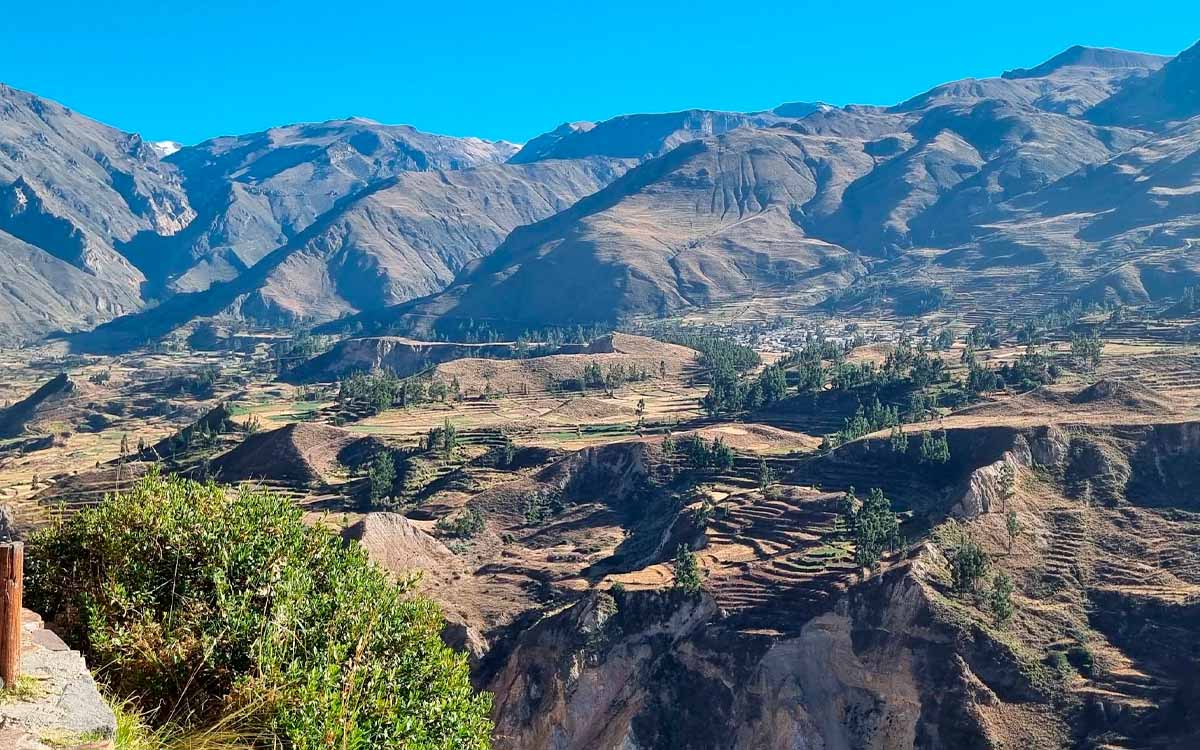
According to Autocolca (Autonomous Authority of the Colca), the deepest point of the canyon reaches 4,160 meters, measured in the Canco sector, Huambo district — an area far from the usual tourist circuit. In the section that most travelers do visit, near the Cruz del Condor, the depth cited most frequently is around 3,270 meters.
Did you know?… the Grand Canyon in the United States has a maximum depth of about 1,800 meters. That is, even taking Colca’s most conservative figure, its deepest point doubles that of the Grand Canyon.
Where is the Colca Canyon located and how is it organized?
The Colca Canyon is found in the Caylloma province, within the department of Arequipa, in southern Peru. The usual access is by road from the city of Arequipa, known as the “White City”.
Colca altitude
One of the things that surprises travelers to Colca the most is how changeable the relief is on a single day of travel. The city of Arequipa is at about 2,335 meters above sea level; from there, the route to the canyon climbs up to the Patapampa viewpoint, the highest point of the trip.
After Patapampa, the road goes down to Chivay, capital of the Caylloma province and gateway to the valley. Those who dare to go down to the bottom of the canyon, on the trekking route to the Sangalle oasis, descend to about 2,150-2,200 meters above sea level. This altitude contrast is the main reason why prior acclimatization is recommended and why you should pay attention to altitude sickness symptoms before starting the trip.
Distances and travel times from Arequipa
- Arequipa – Chivay: Approximately 163-167 km. In private transport or shared transport (tourist minivan) the trip takes between 3 and 3.5 hours. In a regular public bus, the time goes up to about 4 hours due to intermediate stops.
- Arequipa – Cabanaconde: The reported distance varies between 210 and 263 km depending on the source and the exact route. Travel time is around 5 to 7 hours by public bus, or slightly less in a private vehicle.
- Chivay – Cruz del Condor: An extra section of about 1 to 2 hours, generally covered very early in the morning to arrive before the peak activity time of the condors.
In practical terms, this means a single-day trip (full day) involves very early departures (usually between 3:00 and 4:00 a.m.) and days lasting 14 to 15 hours in total, while 2-day tours allow splitting the route with a night of rest in Chivay.
Why is it one of the best tourist attractions in Peru?
The Colca Canyon combines several attractions that are rarely found together in a single destination: unique wildlife, ancient agricultural engineering, living culture, and extreme geographic contrasts. Below are the reasons that make it a must-see stop within any itinerary through southern Peru.
1. The Andean Condor Sanctuary
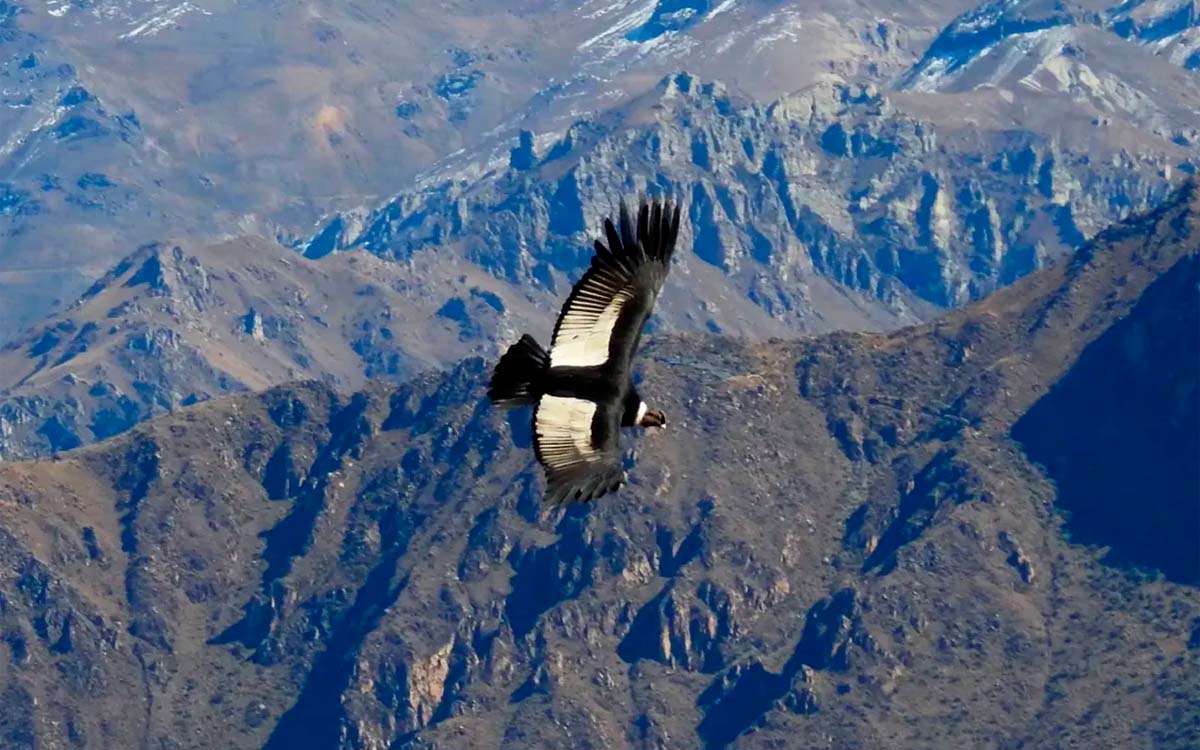
The Cruz del Condor Viewpoint, located between the towns of Maca and Cabanaconde, at about 3,800 meters above sea level, is recognized as one of the best places to observe the Andean condor in the wild. The combination of deep canyon walls and upward air currents, generated when the rock is warmed by the morning sun, creates ideal conditions for these birds to glide at low altitude, sometimes just a few meters from visitors.
Facts about the Andean condor
- Wingspan: Up to 3.2 meters, the largest of any land bird on the planet
- Weight: Between 9 and 15 kg
- Flight capacity: Studies by the University of Swansea and CONICET recorded individuals gliding for more than 170 km and 5 straight hours without flapping their wings, using only thermal currents
- Status: Species categorized as vulnerable due to habitat loss and accidental poisoning by toxic baits; in Peru it is a national symbol and appears on the country’s coat of arms
How does the flight phenomenon work? Thermal currents form when the sun warms the rocky walls of the canyon. The warm air rises and the condors use it to lift themselves without effort, instead of spending energy flapping their wings.
About the Tourist Ticket
Access to the canyon and the viewpoint requires the Colca Valley Tourist Ticket, which is bought at entrance control points or in Chivay. Rates vary by nationality (Peruvians and other foreigners), so it is a good idea to check the current price before the trip, since the figures reported by different operators do not always match.
2. A Museum of Pre-Inca Terracing
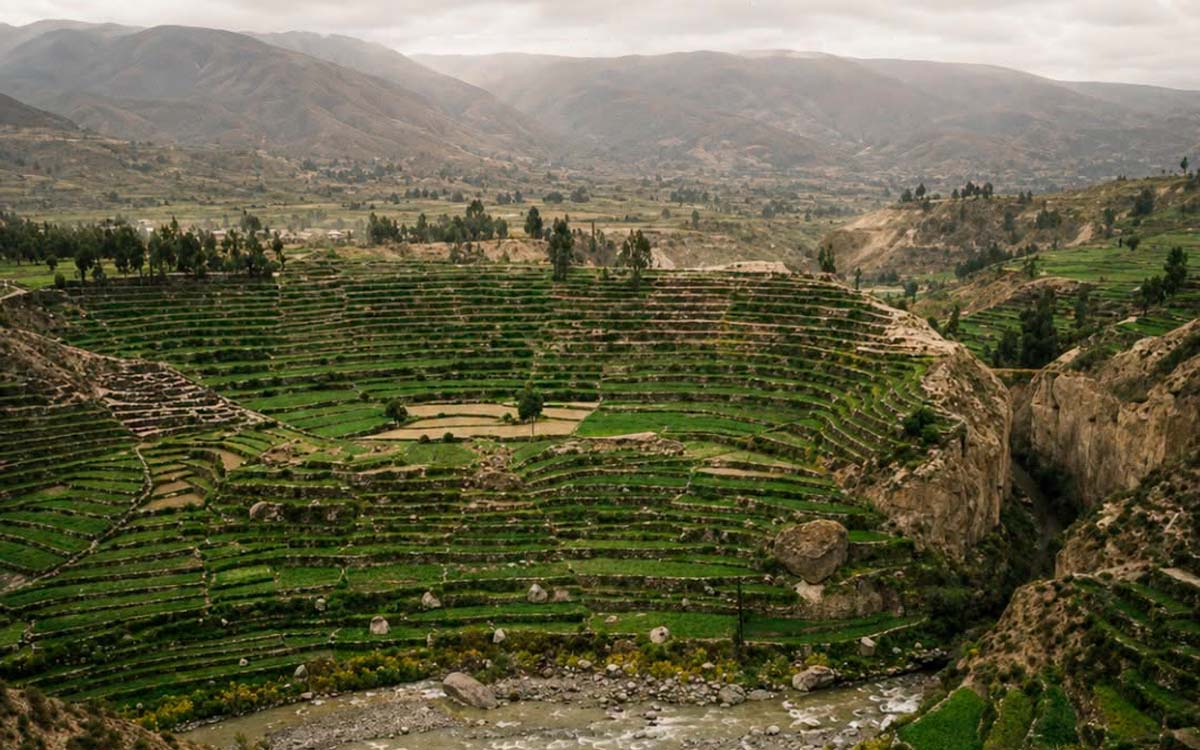
One of the traits that most distinguishes the Colca Valley is the extent of its agricultural terraces (andenes), which cover the mountain slopes on both sides of the river. According to historical records, their construction began with the Collagua people starting in the 11th century, several years before the arrival of the Incas in the region.
These terraces made it possible to farm on steep slopes, control soil erosion, and make the most of available water through canal irrigation systems, in an area where rain-fed agriculture is not viable. The system is still in active use today, where fourteen rural communities in the valley continue to farm these terraces using traditional methods, combining agricultural work with rituals of worship to the water and the apus (sacred mountains) that date back to pre-Inca times.
Walking or traveling along the road that borders the valley allows you to see this landscape, full of green terraces, still worked by the same families who inherited the technique from their Collagua and Cabana ancestors.
3. Culture, Traditional Clothing and Towns
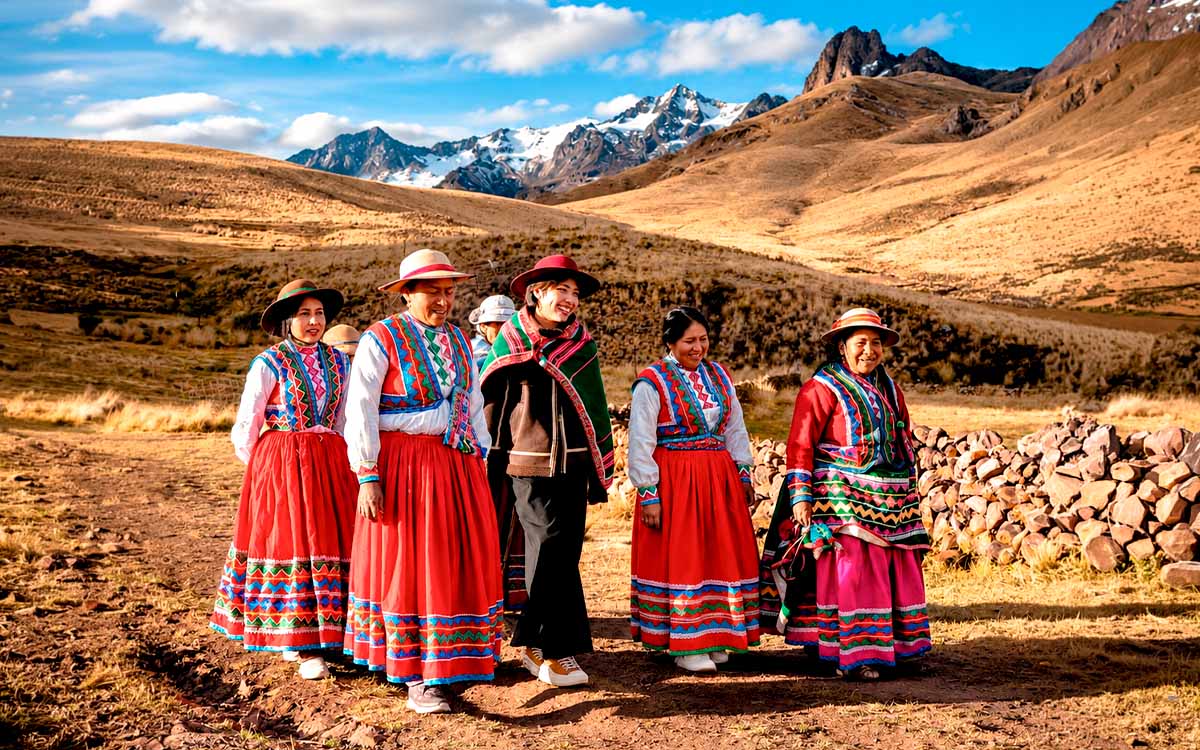
Before the arrival of the Incas, the Colca Valley was inhabited by two ethnic groups with very different identities: the Collaguas, of the Aymara language, settled in the upper part of the valley and dedicated mainly to the herding of camelids; and the Cabanas, of the Quechua language, settled in the lower part and dedicated to corn farming. Both groups lived alongside the Incas starting from around 1320 A.D., but kept their own traditions up to the present day.
That cultural legacy lives on in the towns visited along the tourist route:
- Chivay: Capital of Caylloma province and the usual starting point to explore the valley. It is also the town with the most tourist infrastructure.
- Yanque: Known for its colonial church and daily performances of traditional dances in the main square.
- Maca: Declared a Historical Monument of Peru, with a colonial church that survived several earthquakes.
- Pinchollo: Small town on the route to Cruz del Cóndor, with simpler colonial architecture and fewer tourists.
A cultural symbol shared by the whole valley is traditional embroidery, declared Cultural Heritage of the Nation in 2018 for its technical and historical value, deeply rooted in the Collagua and Cabana worldview. This art is especially displayed in the costumes of the Wititi dance, which is performed every December 8 in Chivay during the festival of the Virgin of the Immaculate Conception, the most important celebration in the province.
4. The Contrast of Its Microclimates
Few destinations in Peru allow you to go, in a single day, from a landscape of snow-capped peaks and vicuñas grazing in the puna, to a temperate valley with vegetation and warm water pools. That contrast begins at the Patapampa viewpoint, at nearly 4,900 meters above sea level, where the landscape is arid, cold, and dominated by volcanoes; it continues in Chivay and the towns of the valley, at about 3,600 meters, with a temperate climate by day and cold at night; and it ends, for those who dare to trek, in the Sangalle oasis, at the bottom of the canyon, at about 2,150-2,200 meters above sea level.
Sangalle is the clearest example of this contrast: after several hours of descent along dry and rocky trails, the landscape suddenly changes to palm trees, tropicalized vegetation, and natural spring-fed water pools, a unique microclimate that contrasts with the dryness of the surrounding slopes. It is common for trekkers to spend the night there before hiking back up to Cabanaconde the next day.
5. Hot Springs
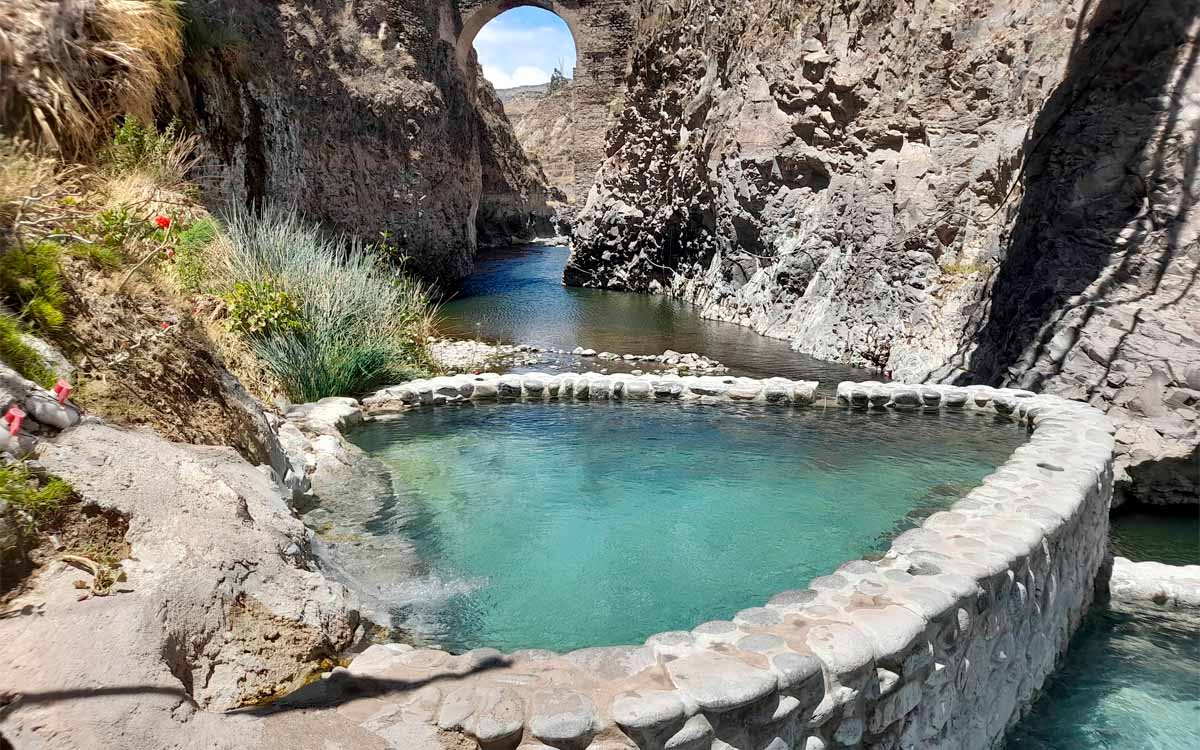
The Colca Valley is also one of the most visited thermal tourism destinations in southern Peru, thanks to the area’s volcanic activity. The best-known public complexes are:
- La Calera (Chivay): About 4-5 km from the town, it has five pools fed by waters that originate at over 80°C in the Cotallumi volcano and are cooled to 38°C for bathing. Its waters contain calcium, zinc, and iron, and are said to have benefits for muscle and bone pain. Usual hours: from 4:00 a.m. to 7:00 p.m.
- Chacapi (Yanque): About 2 km from the main square, with pools whose reported temperature varies between 45°C and 50°C depending on the source. It is a simpler and less crowded alternative than La Calera.
Both are managed by district municipalities, with affordable access rates (between S/10 and S/15 approximately, subject to change). For those doing the full-day circuit, a stop at La Calera is usually included before returning to Arequipa; those staying a night in Chivay can also take advantage of the evening to visit them with fewer tourist crowds.
Frequently Asked Questions
- How many days are needed to visit Colca?
It depends on the kind of experience you are looking for:- 1 day (full day): Fastest option, ideal if time is limited. It involves a very early departure (3:00-4:00 a.m.) and 14-15 hour days.
- 2 days (traditional): The most recommended option. It allows you to spend the night in Chivay, arrive more rested at the Cross of the Condor, and visit the towns of the valley without rushing.
- 2-3 days (Trekking in the Colca Canyon): For those who want to hike down to the bottom of the canyon and stay overnight in the Sangalle oasis, with hikes of several hours each day.
- Is it dangerous to visit the Colca Canyon?
It is not a high-risk destination if you take basic precautions. The main care points are: Stay on marked trails, respect the altitude, bring enough water and sun protection. - Can you visit on your own or is it mandatory to go with a tour?
It is completely possible to visit Colca on your own. You can get there by shared taxi or public bus from Arequipa to Chivay or Cabanaconde, and move between towns using local transport. However, an organized tour saves headaches in several ways:- Local bus schedules between towns are limited and do not always match the best time to see condors (7:00-9:30 a.m.)
- The tour includes a guide, which helps you understand the historical and cultural background of each stop
- It simplifies logistics if available time is short (for example, a full day)
Traveling on your own, on the other hand, is usually cheaper and allows more schedule flexibility, although it requires better planning for transfers.
- How much does the Colca tourist ticket cost?
Access to the circuit (which includes the Colca Canyon, the Salinas and Aguada Blanca Reserve, and the Valley of the Volcanoes) requires the Colca Tourist Ticket (BTC). Reference prices are:- 70 soles for foreigners,
- 40 soles for Latin American tourists
- 20 soles for Peruvians (children from 6 to 15 years old pay reduced rates).
The ticket is bought in cash, at the control points in the area or at the Chivay Interpretation Center. It is a good idea to check the current price before traveling, since these rates can change.
- What is the best time to see the condors?
There is no absolute guarantee in any month of the year, since it is a wild animal. However, the dry season (roughly from April to November) usually offers clearer skies, which favors the creation of thermal currents and, with that, the chances of sightings. - What is the difference between the Colca Valley and the Colca Canyon?
The Colca Valley is the inhabited area, with towns like Chivay, Yanque, and Maca, farming terraces, and hot springs. The Colca Canyon is the section where the river cuts deep down, near the Cross of the Condor Viewpoint. In practice, tourist tours cover both on the same circuit.